Rememory
— AI Guided Emotional Memory UX Case Study
Duration: Aug 2025 – Jan 2026
My Role: UX Researcher · UX Designer · Interaction Designer
Tools: Figma, Miro, Dovetail, Python, Unity, Framer
Deliverables: UX Research Report, Personas, Journey Map, Figma Prototype, VR Concept Demo
Project Summary
ReMemory explores how people can preserve and reconnect with emotional memories through an AI guided interactive digital experience.
The project combines mixed-method UX research, product thinking, and immersive interaction design.
UX Research
Product Thinking
Mixed Methods
Emotional Design
VR Concept
Background & Problem Context
Context
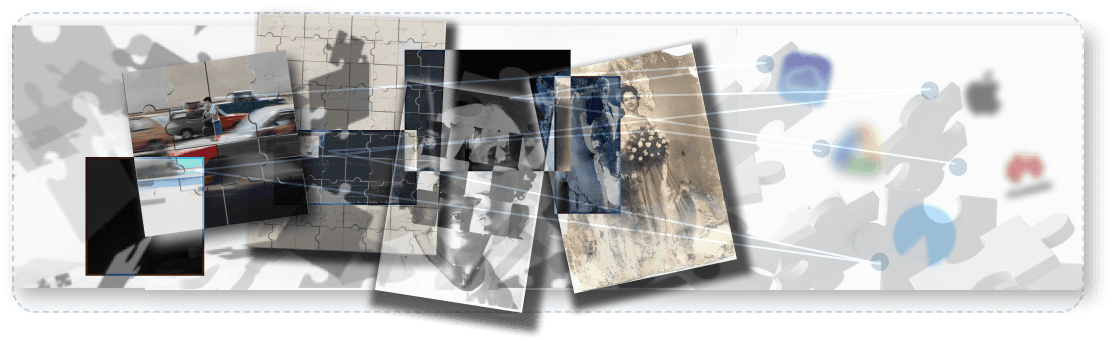
People record thousands of moments across photos, videos, and notes, but rarely revisit them with the same emotional intensity. Emotional context gets lost as memories spread across platforms and time.
Problem Statement
How might we help people preserve and emotionally reconnect with their memories in a way that feels meaningful, interactive, and easy to maintain over time?
Product Opportunity
Create an AI-driven emotionally intelligent system that visualizes memories as interactive experiences.
Support users with gentle AI prompts and guided reflection flows.
Increase engagement and retention through emotional connection.
User Pain Points
Memories are scattered across different devices and apps.
Most tools focus on storage, not emotional experience.
Users rarely have time or tools for reflective revisiting.
Research Plan & Methods
Research Objectives
Understand how users currently store and revisit personal memories.
Explore emotional triggers and how people describe meaningful experiences.
Identify opportunities for digital tools to support emotional reflection.
Methods
1:1 Semi-structured interviews (8–10 participants).
Online survey to validate behaviors and preferences.
Diary study to capture real-life memory recall moments.
Lightweight focus group to test early concepts.
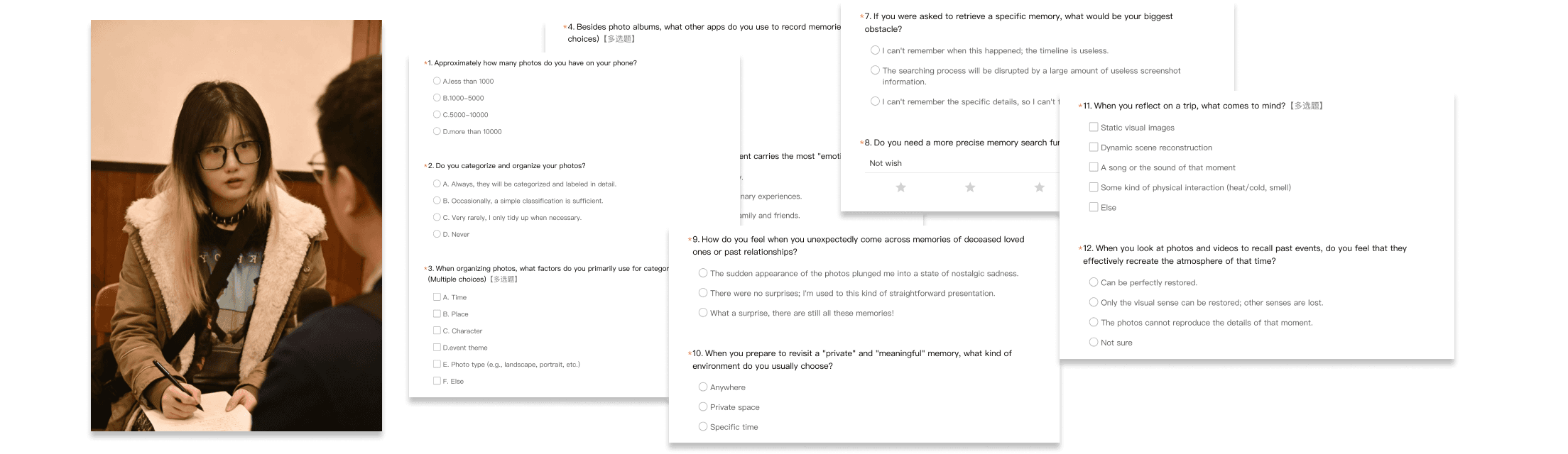
Survey Questionaire
Distribution/collection: Sent to 86 people; 65 valid responses collected over 2 weeks (online form).
Sample split:Record a lot but seldom organize(25);record not enough(18);record a lot and organize(22).
Survey Results
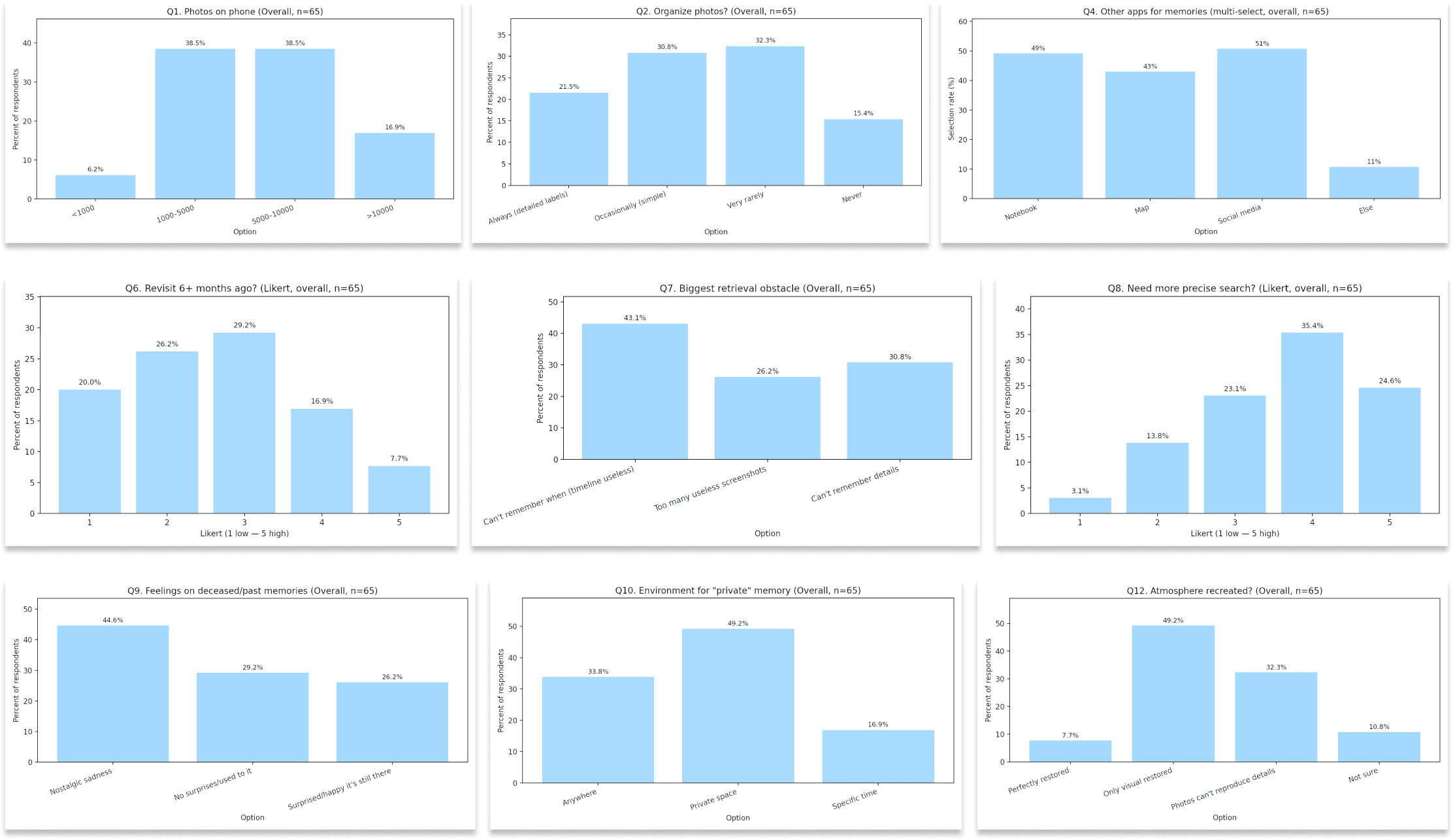
Recording scale: Large number of photos and the sheer volume of information are becoming a source of stress.
55.4% of users have more than 5000 photos in their phone's photo album (5000–10000: 38.5%, >10000: 16.9%).Organization habits: Most people have inconsistent organization habits.
Detailed organization: 21.5%, Occasional simple organization: 30.8%, Rarely/Never organize: 47.7%"Review" frequency: Most people don't frequently review content from 6 months ago.1–2 (low frequency review): 46.2%; 4–5 (high frequency review): 24.6%
The biggest obstacles to retrieval: Forgetting when it happened: 43.1%; Screenshots/irrelevant information: 30.8%; Difficulty recalling details: 26.2%
The demand for precise search is very strong.4–5 (Strong demand): 60.0%; 3 (Neutral): 23.1%; 1–2 (No need): 16.9%
"Sensory Reconstruction of Memory": Only visual aspects can be recalled: 49.2%; Details cannot be recalled: 32.3%; Complete recall: 7.7%
Privacy and Psychological Protection: Private memory environment: 49.2%; Encountering deceased loved ones/past relationships: Nostalgic sadness 44.6%
Sharing/Externalization of records: Social media: 50.8%; Notebook: 49.2%
Key Research Insights
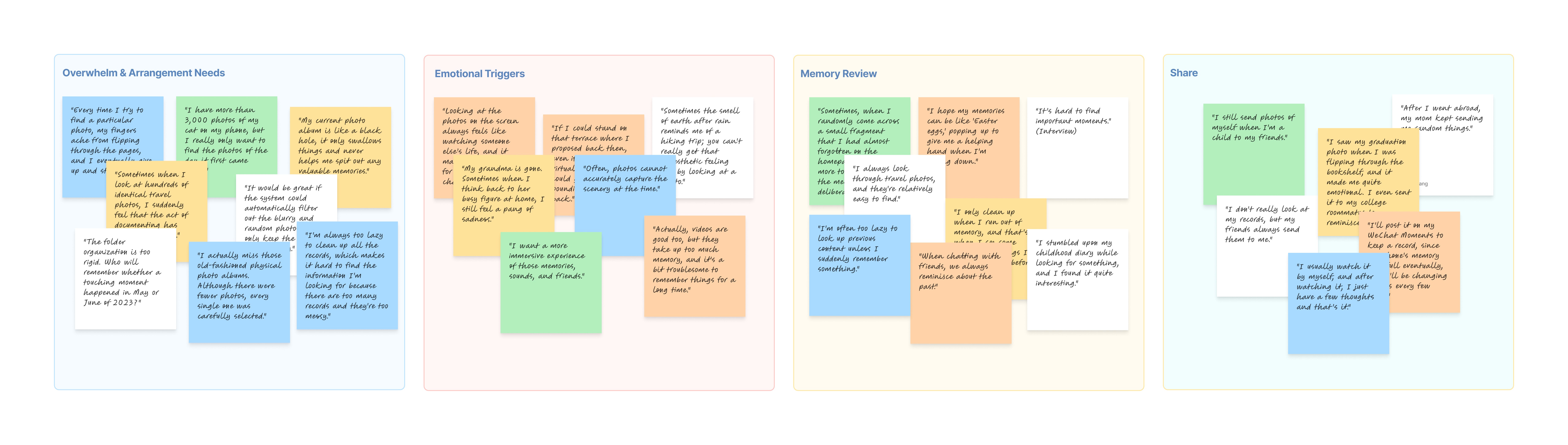
Insight 1
Users hard to find the specific memory, lack of tools for "extracting meaning from massive amounts of information."
Insight 2
Physical triggers (touch, sound, environment) often recall stronger emotional memories than digital images alone.
Insight 3
Although hard to reminiscing, the value of a memory is often highest when it is awakened by chance.
Insight 4
Sharing with specific groups of people can create a psychological connection.
User Persona & Journey
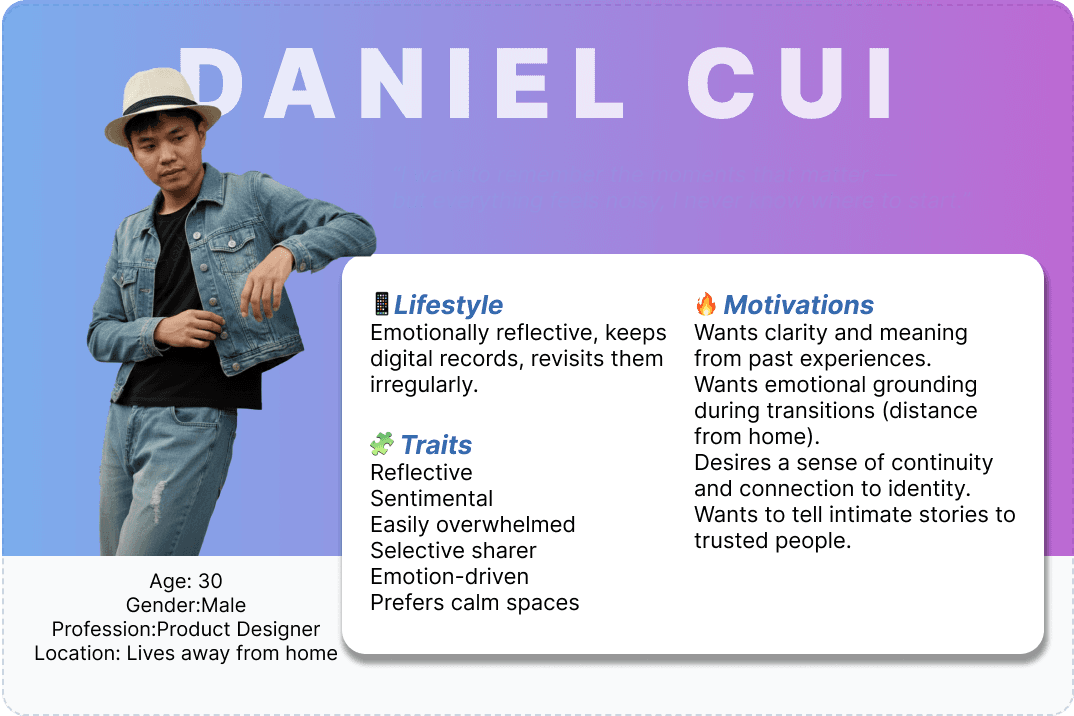
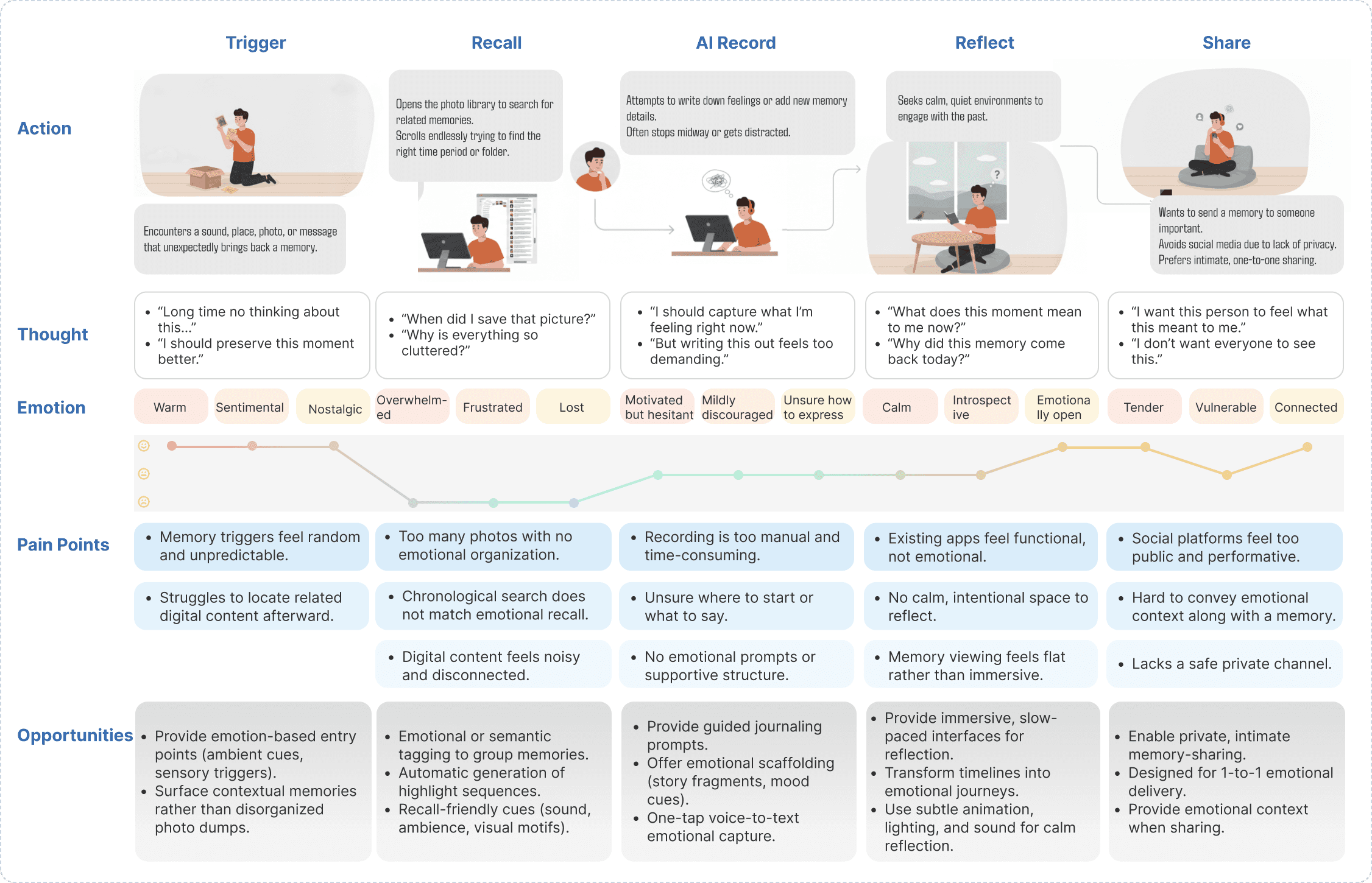
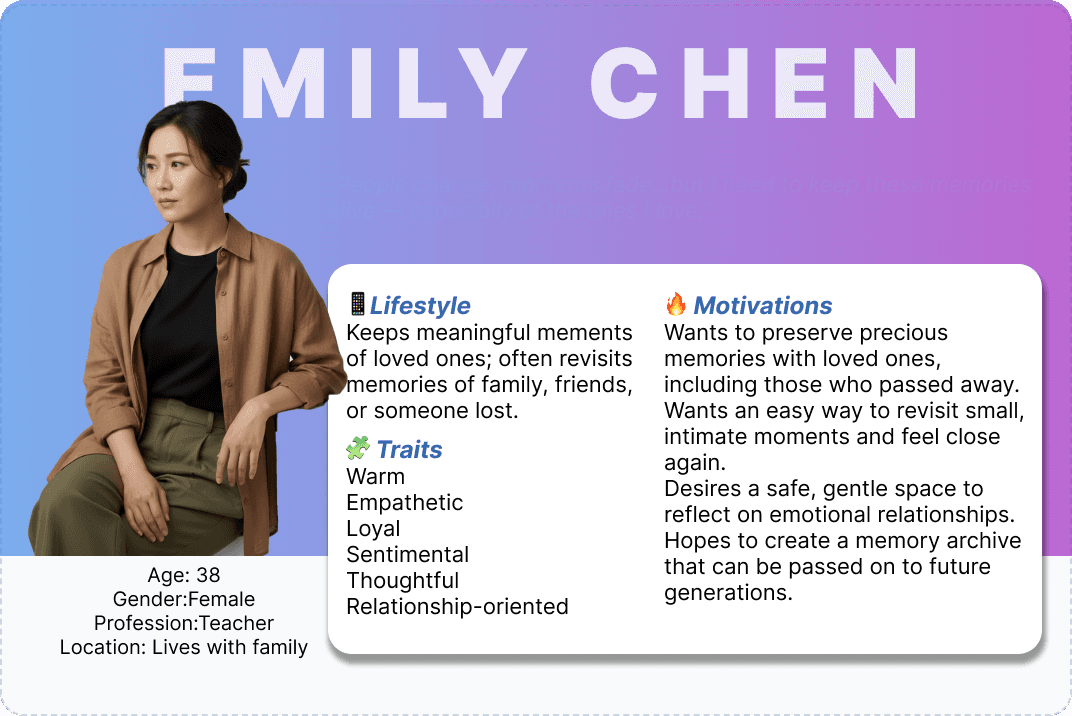
Persona — The Nostalgic Storyteller
Pain Points:
Feels overwhelmed by endless photos and digital clutter.
Struggles to find emotional moments among noise (too many distractions).
Feels guilty for “forgetting” important memories.
Lacks a calm, safe environment for introspective memory revisiting.
Cannot organize memories by emotional meaning, only by time or folder.
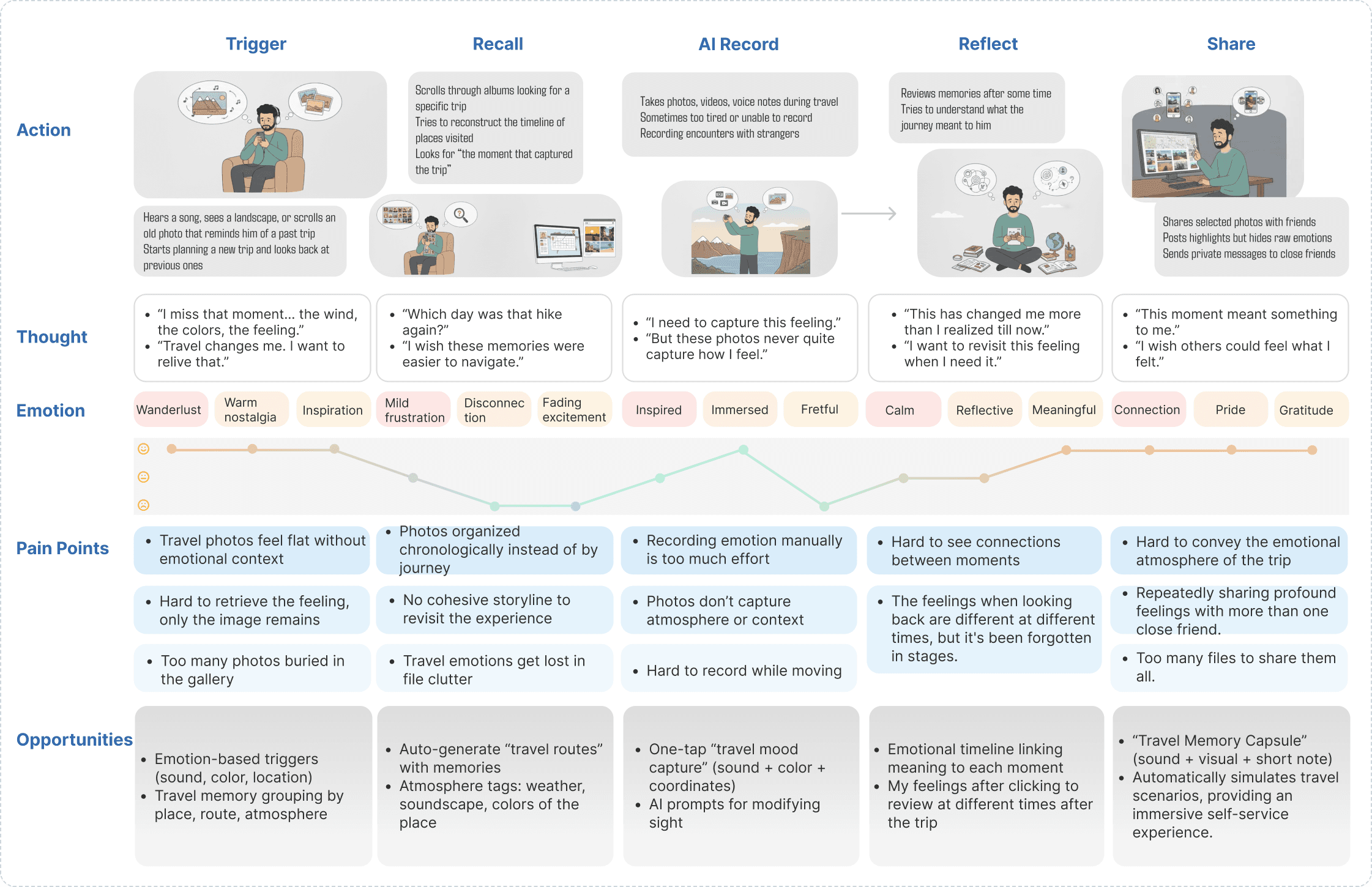
User Journey (High-Level)
User Persona & Journey
Persona — The Nostalgic Storyteller
Pain Points:
Feels overwhelmed by endless photos and digital clutter.
Struggles to find emotional moments among noise (too many distractions).
Feels guilty for “forgetting” important memories.
Lacks a calm, safe environment for introspective memory revisiting.
Cannot organize memories by emotional meaning, only by time or folder.
User Journey (High-Level)
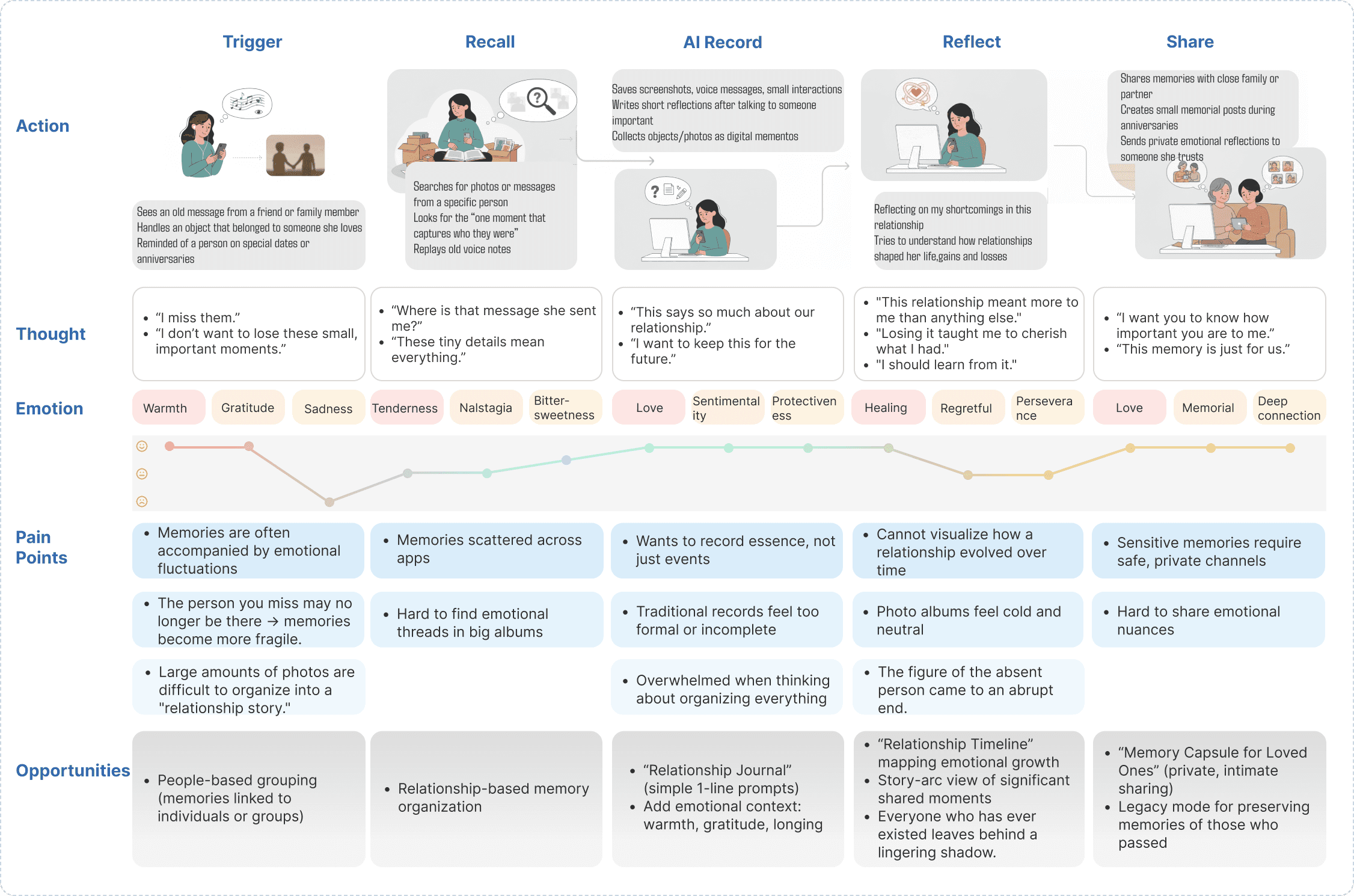
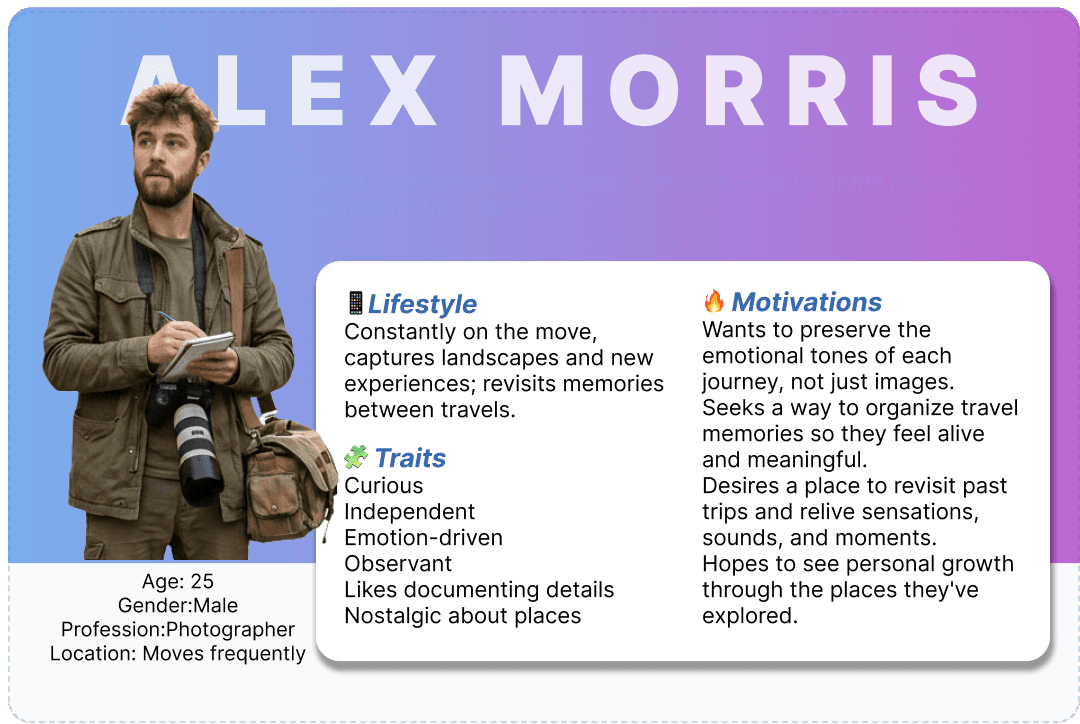
User Persona & Journey
Persona — The Nostalgic Storyteller
Pain Points:
Feels overwhelmed by endless photos and digital clutter.
Struggles to find emotional moments among noise (too many distractions).
Feels guilty for “forgetting” important memories.
Lacks a calm, safe environment for introspective memory revisiting.
Cannot organize memories by emotional meaning, only by time or folder.
User Journey (High-Level)
Ideation & Concept Development
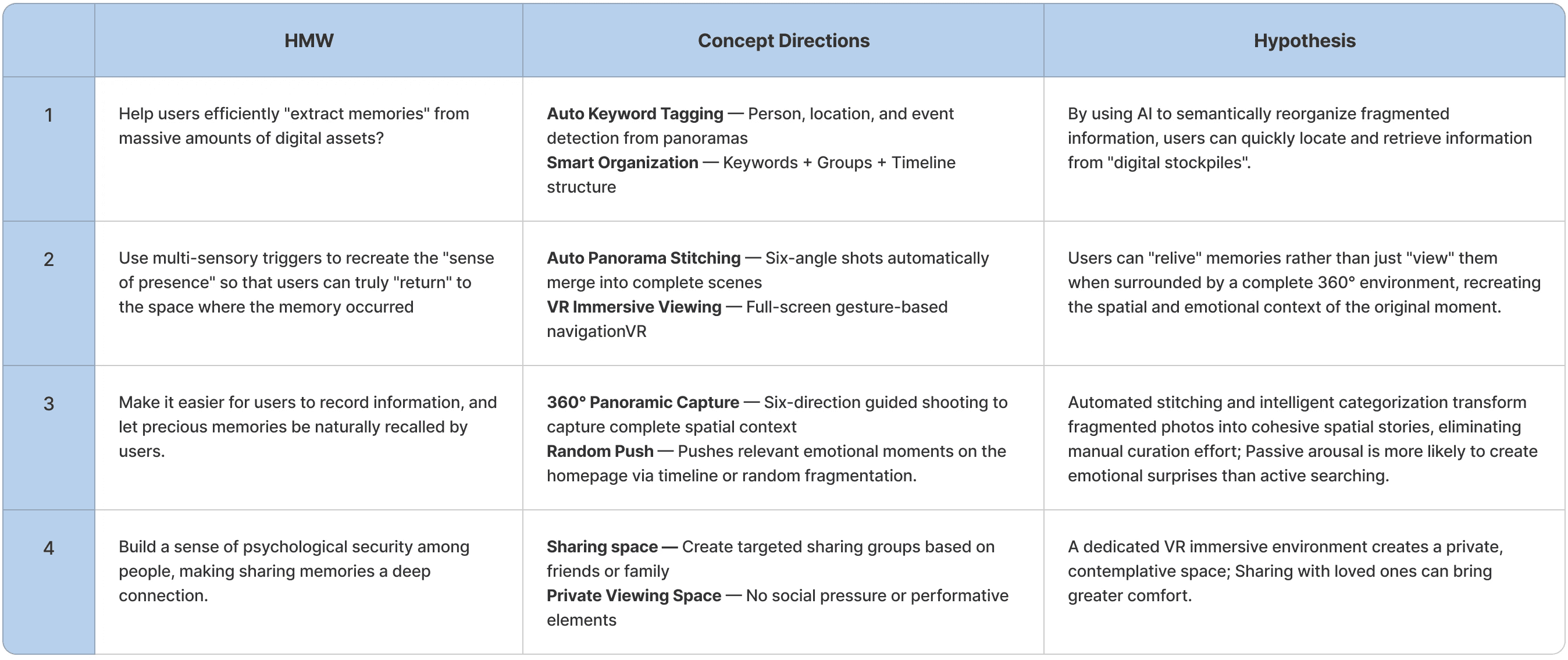
How Might We...
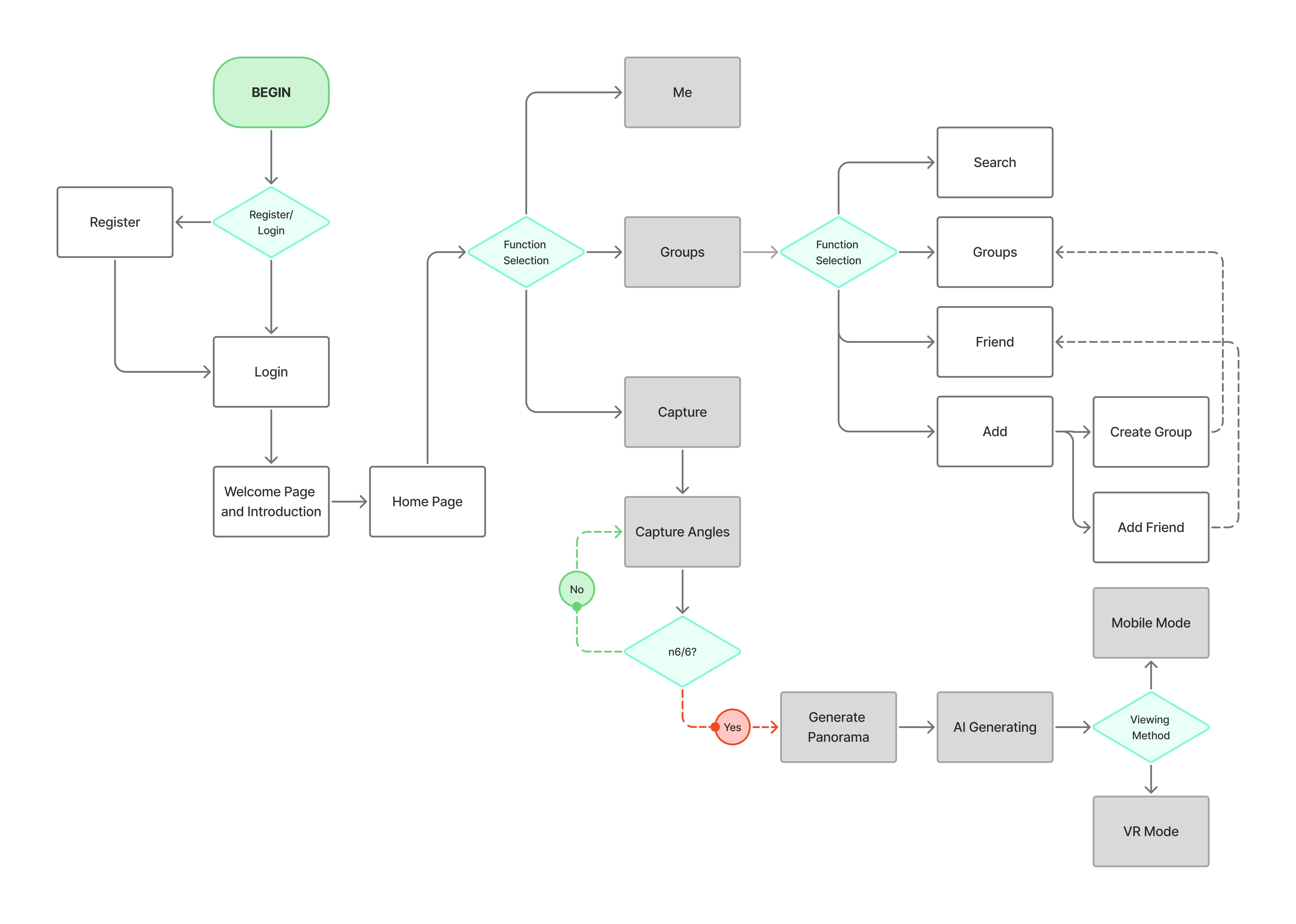
Interaction flow diagram
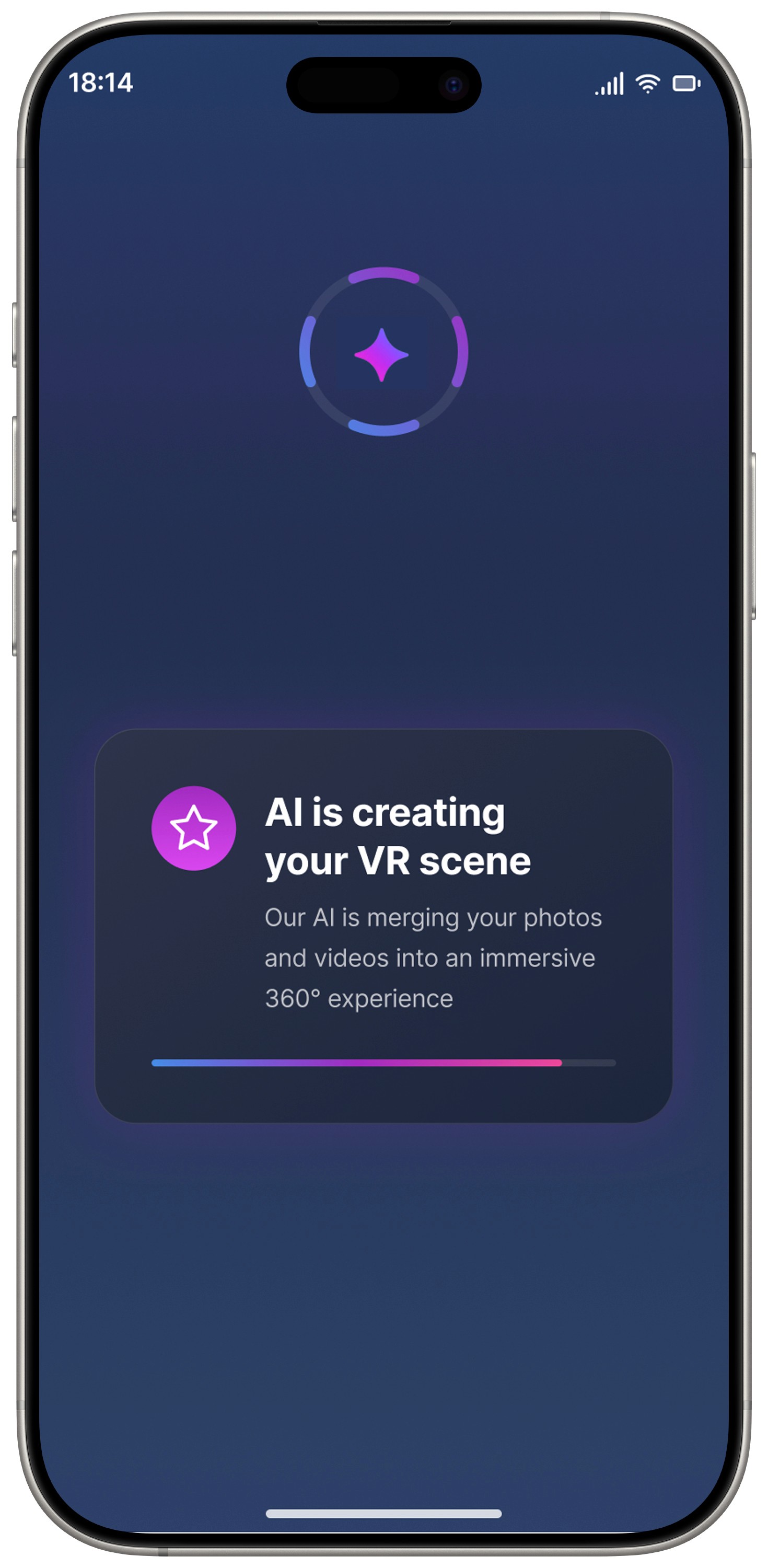
Core User Flow: Capture Guidance → Multi-angle Collection → Auto-stitching → Keyword Tagging → Immersive Playback → Social Sharing
UX & UI Design
Information Architecture
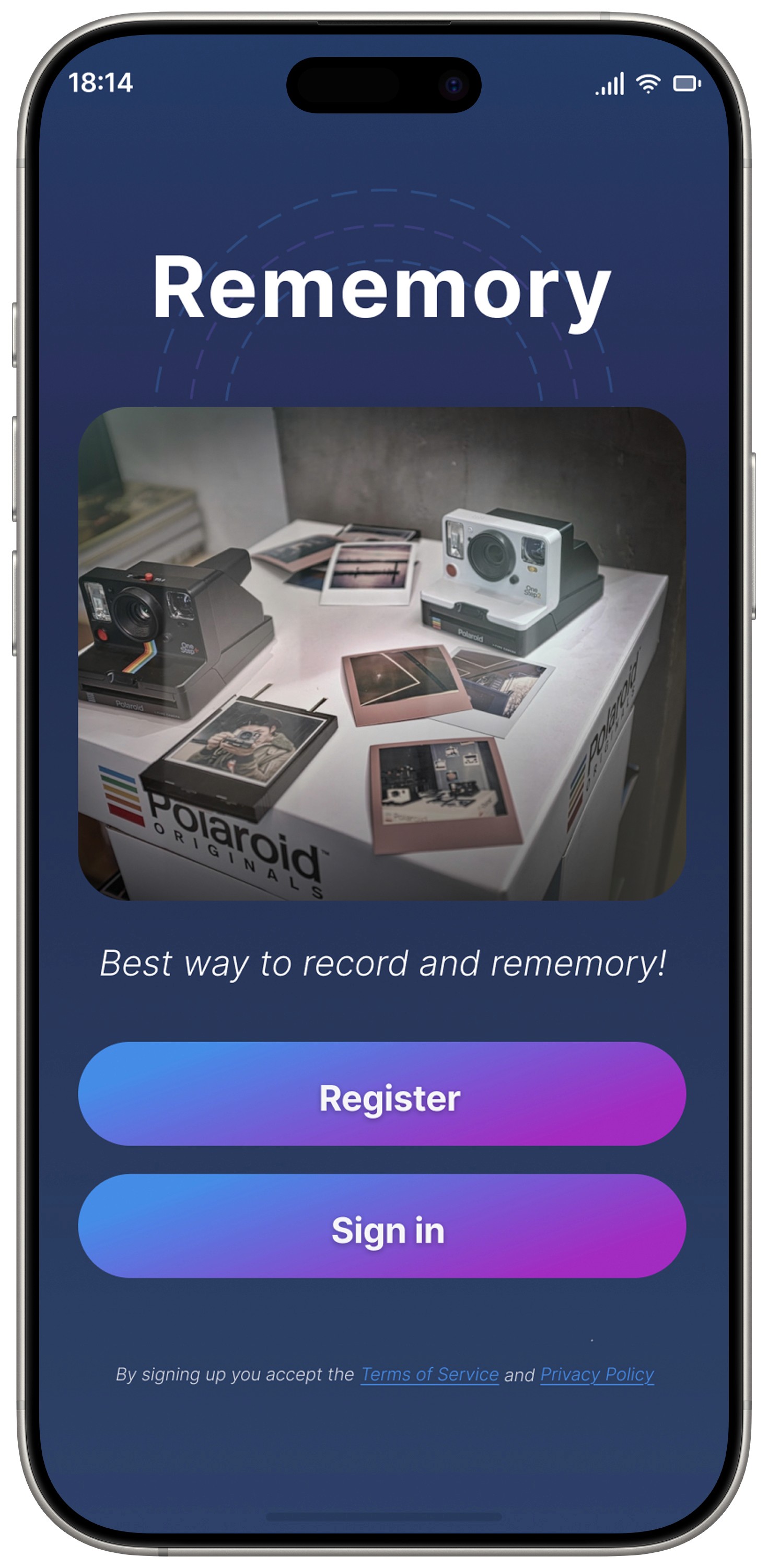
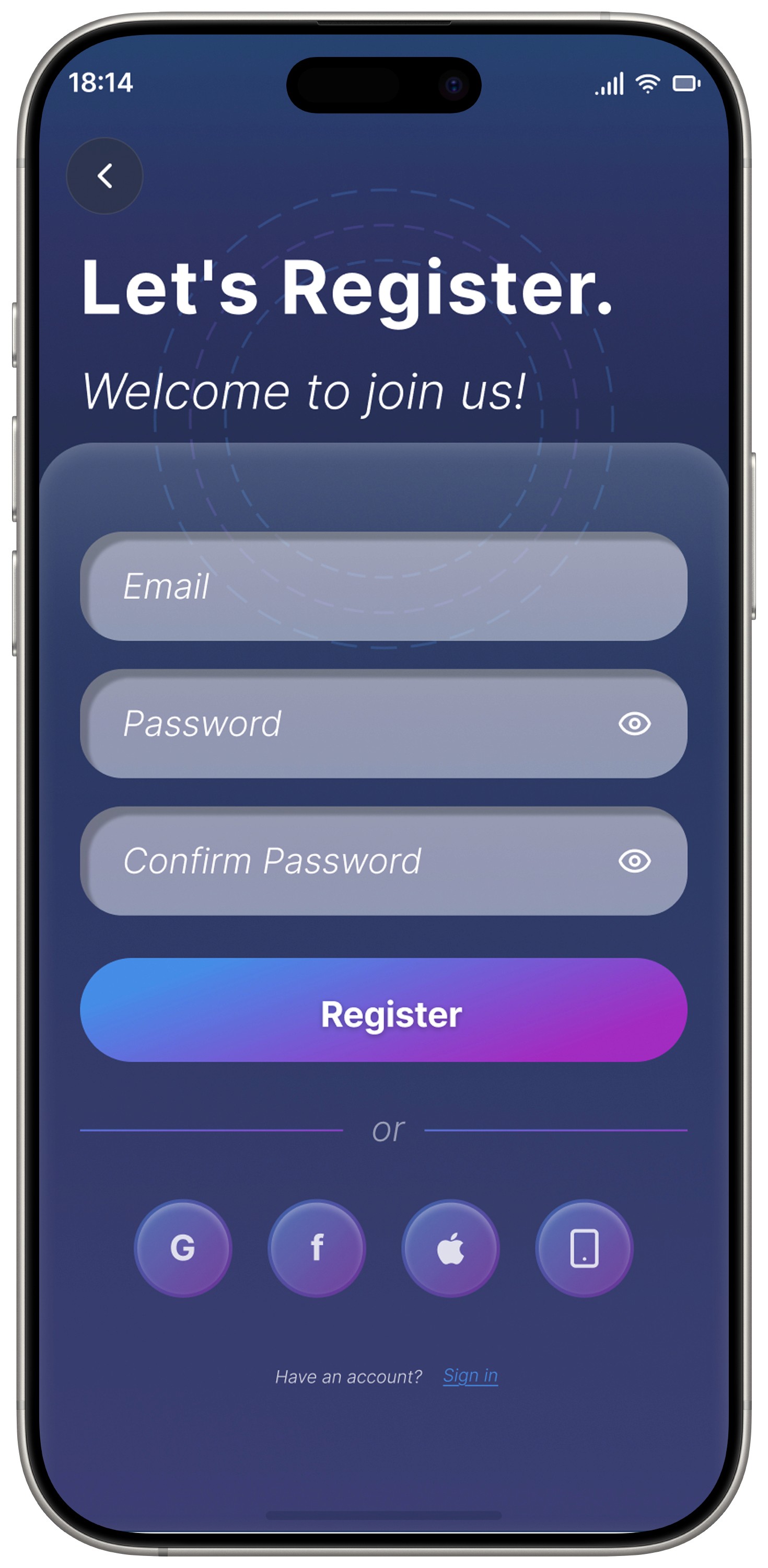
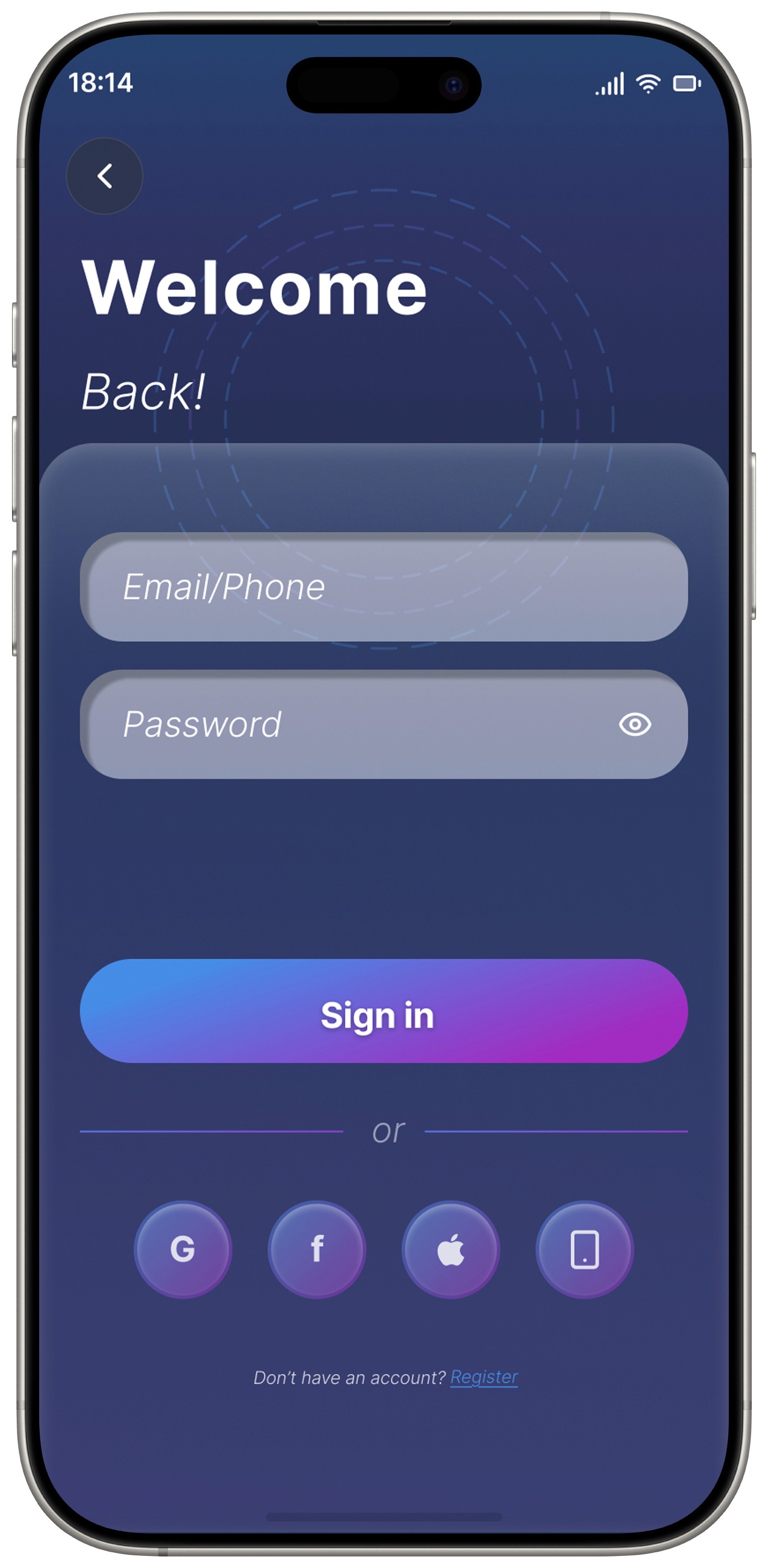
LOGIN PAGE
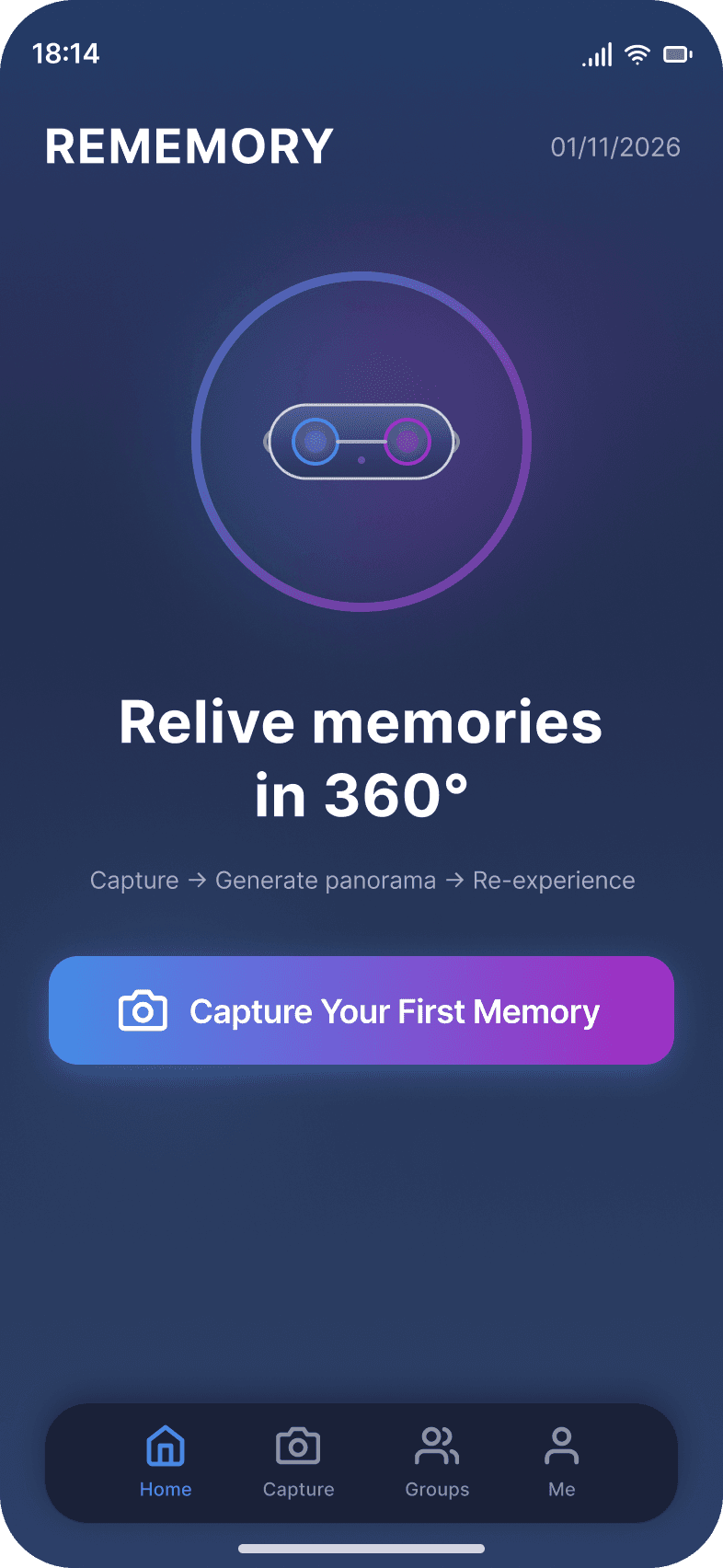
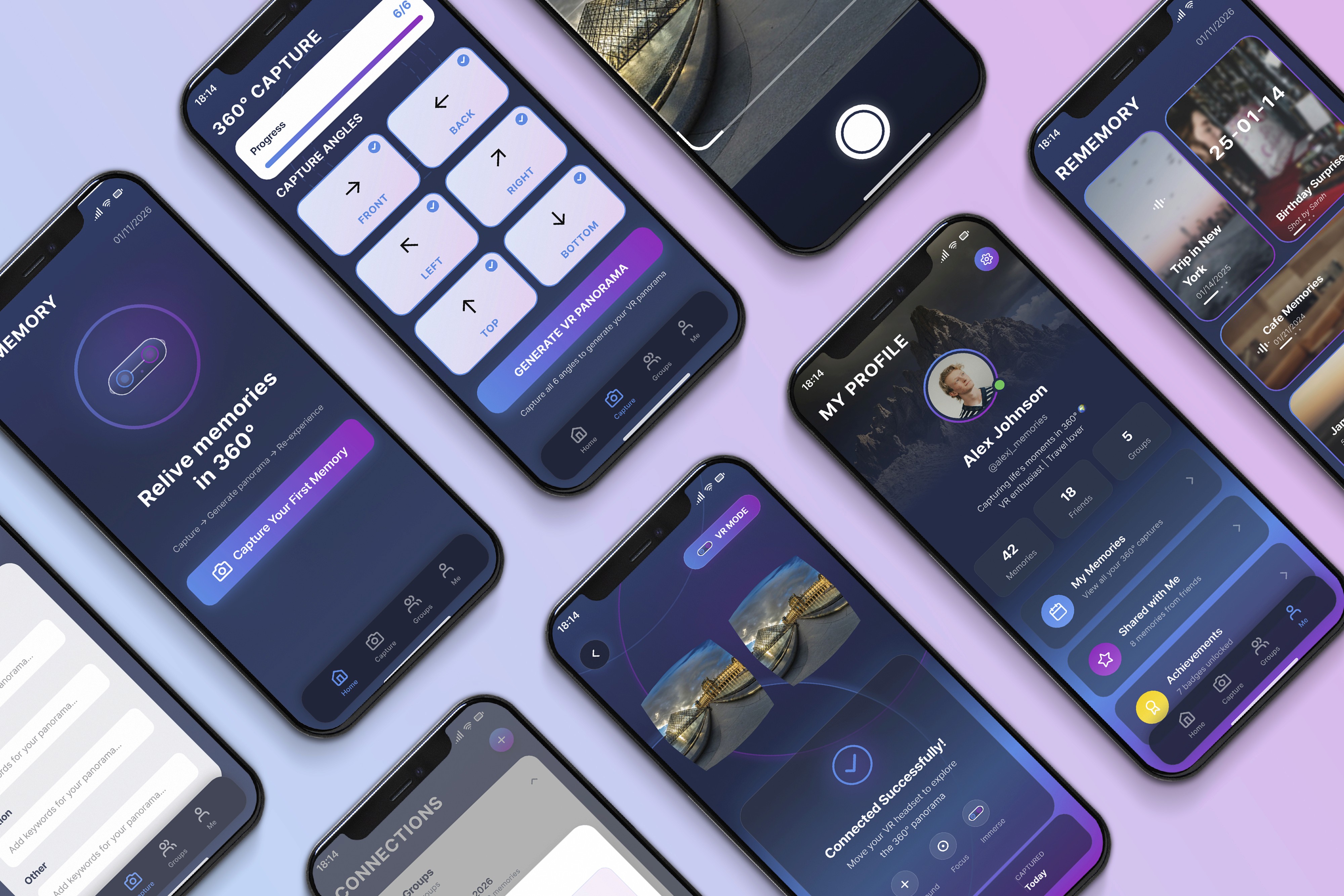
Home — VR headset showcase and panoramic memory timeline browsing
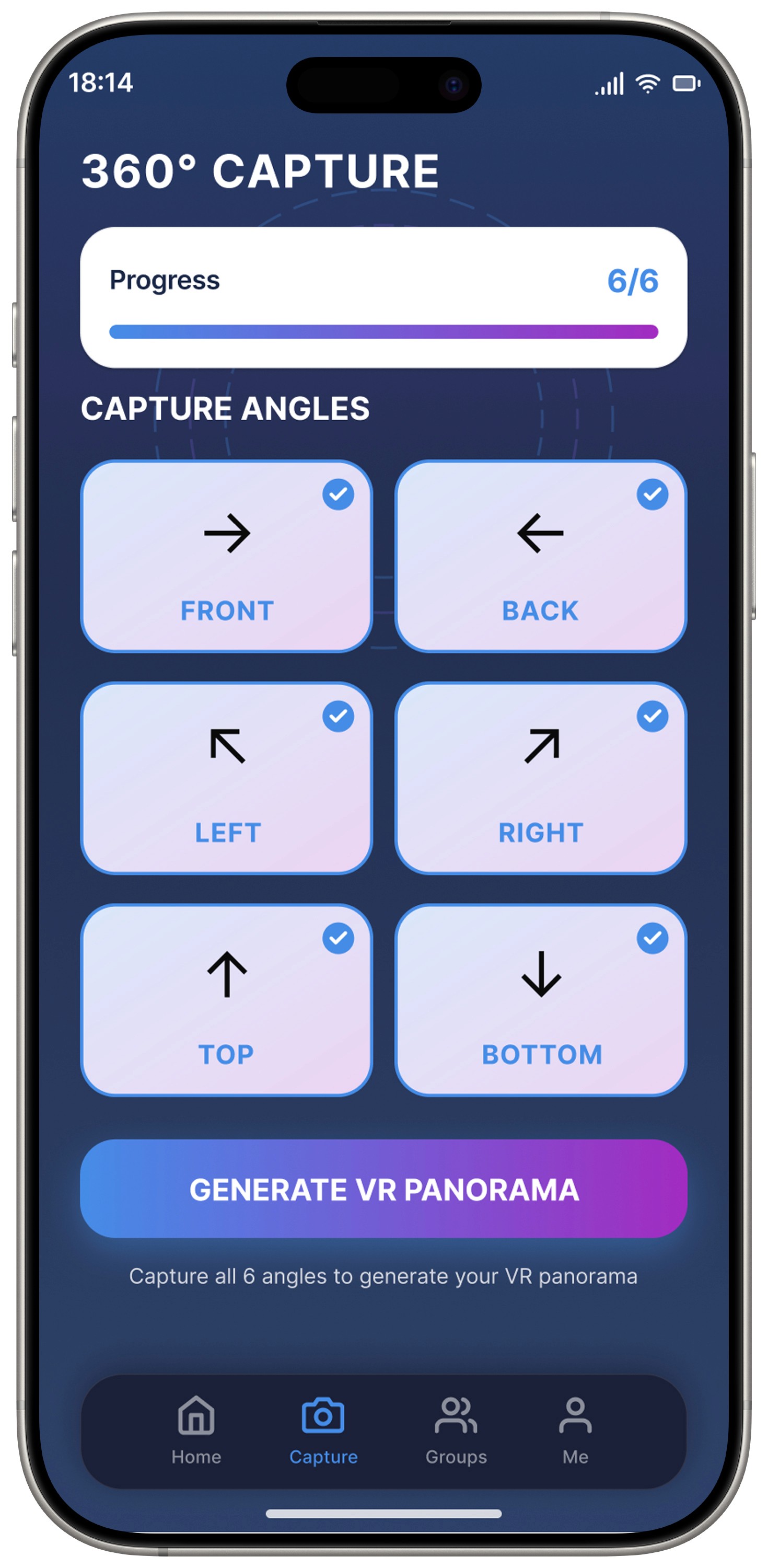
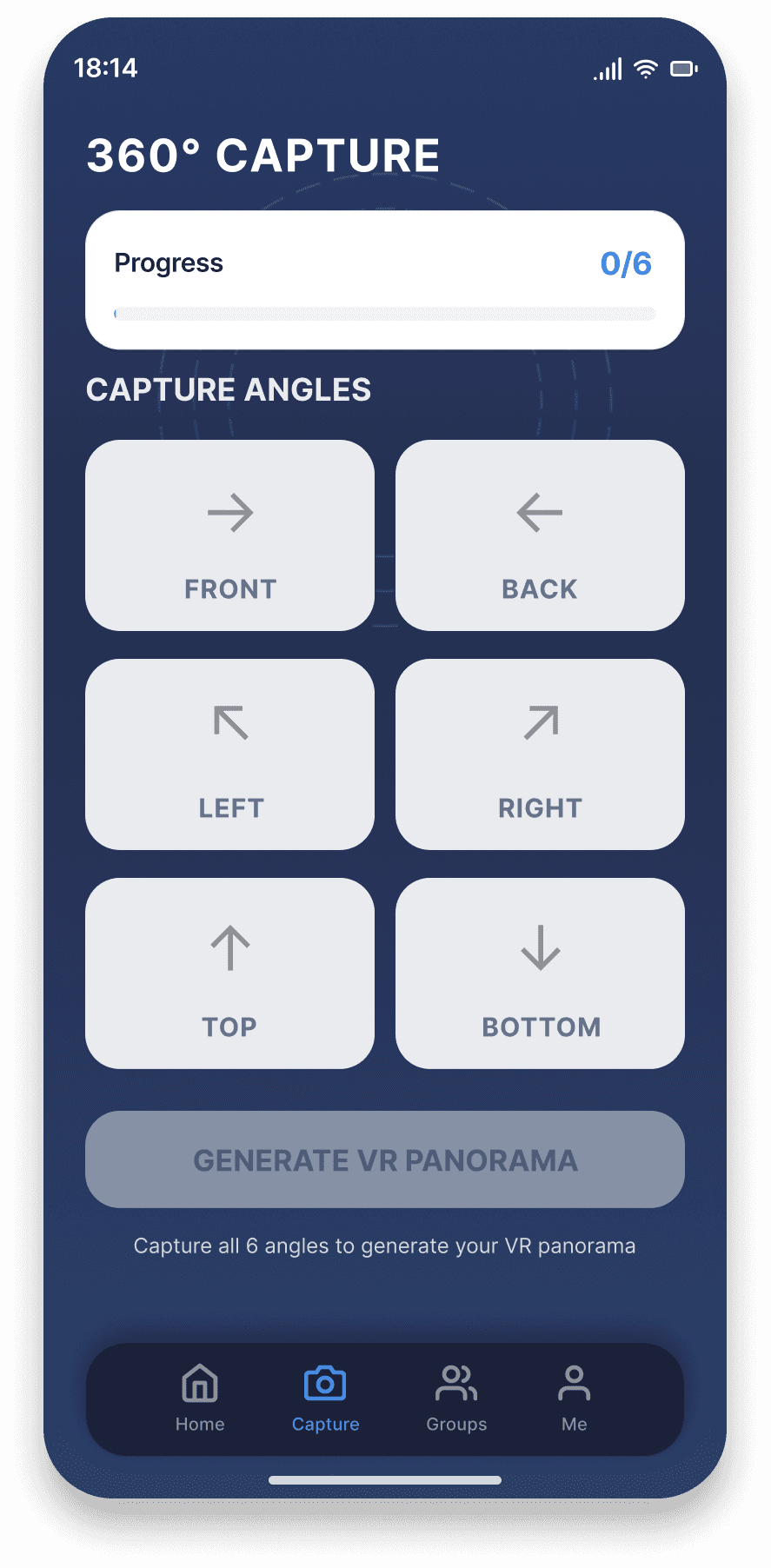
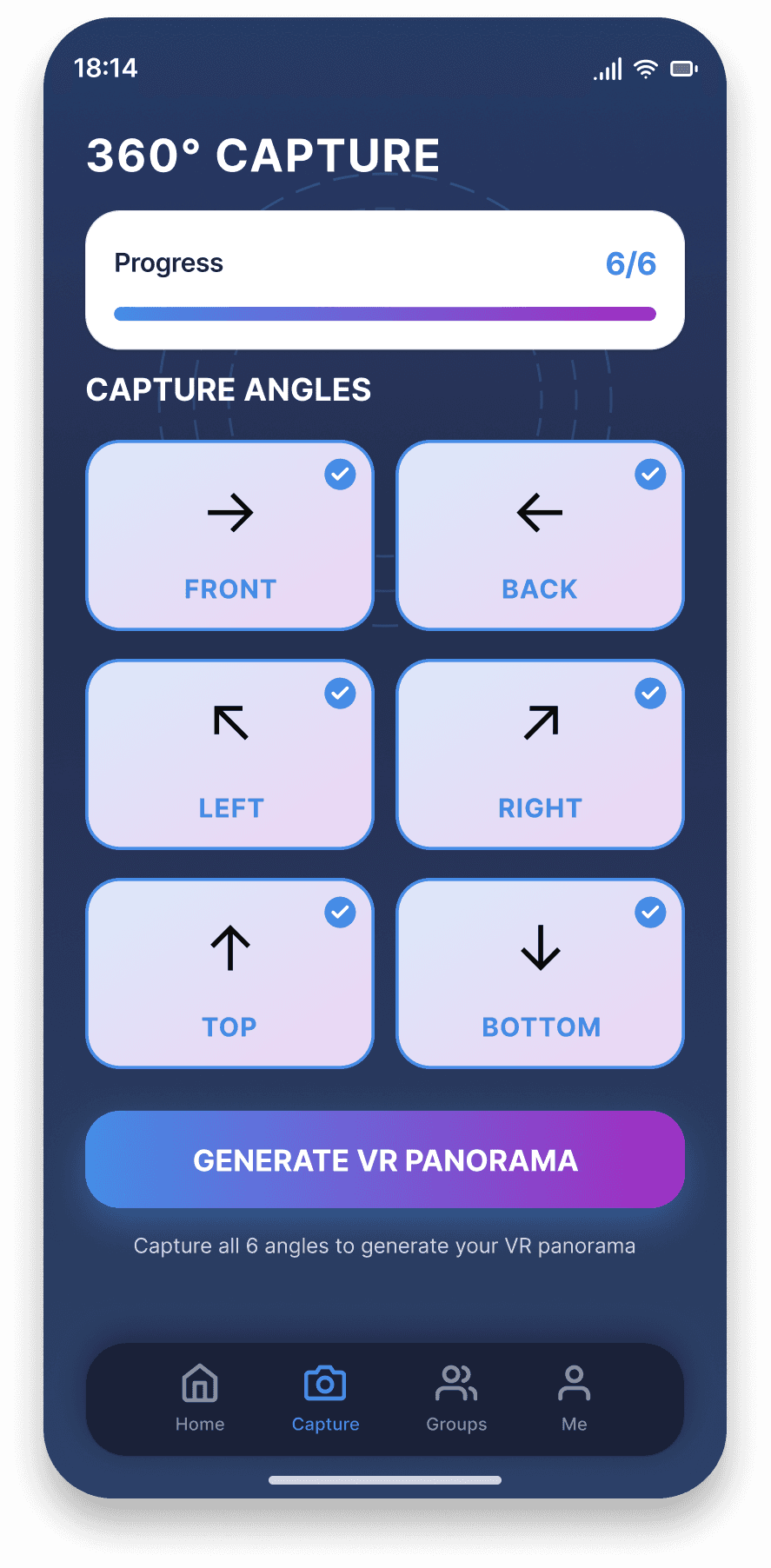
Capture — Six-direction shooting guidance and panoramic content creation workflow
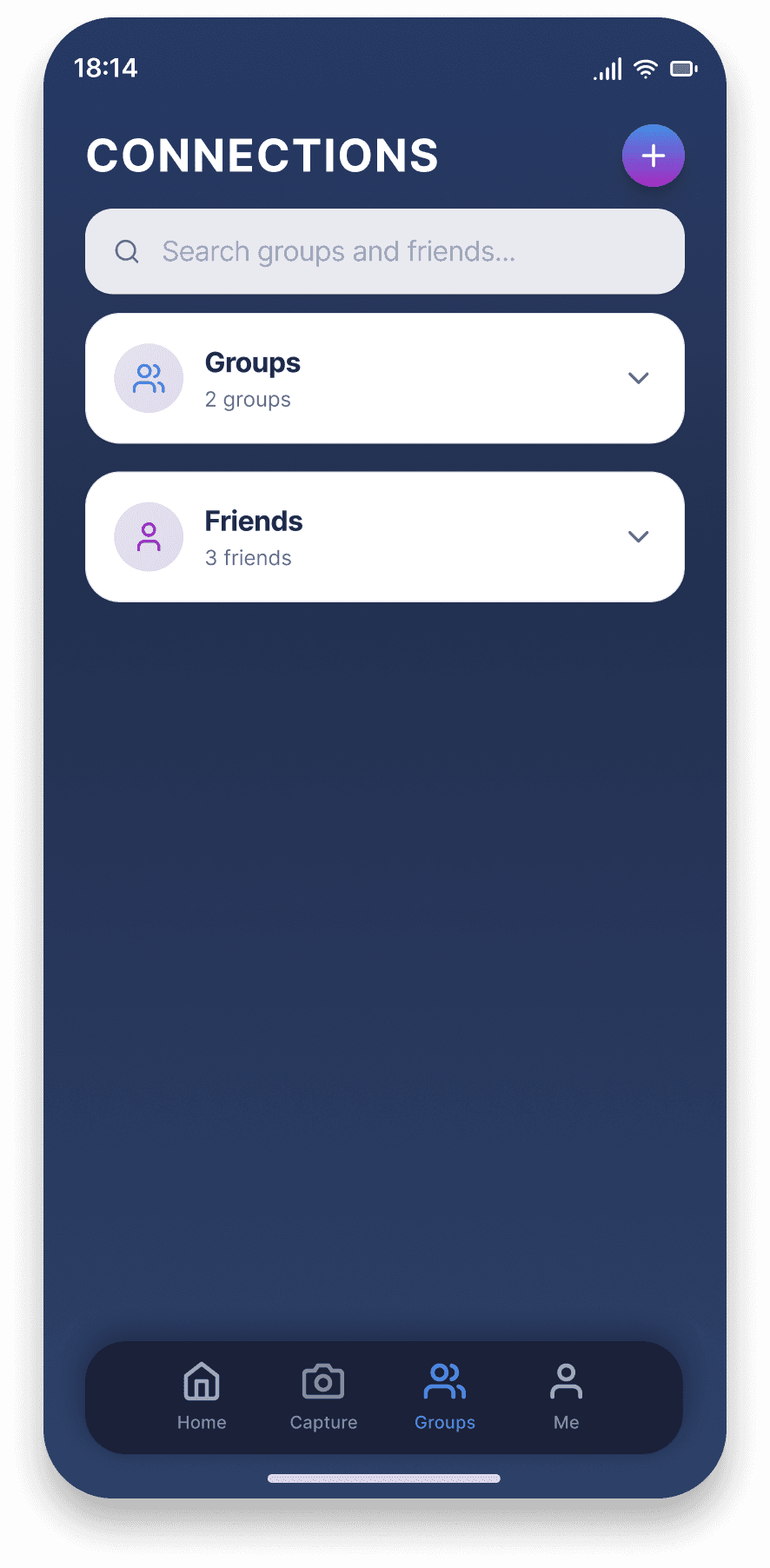
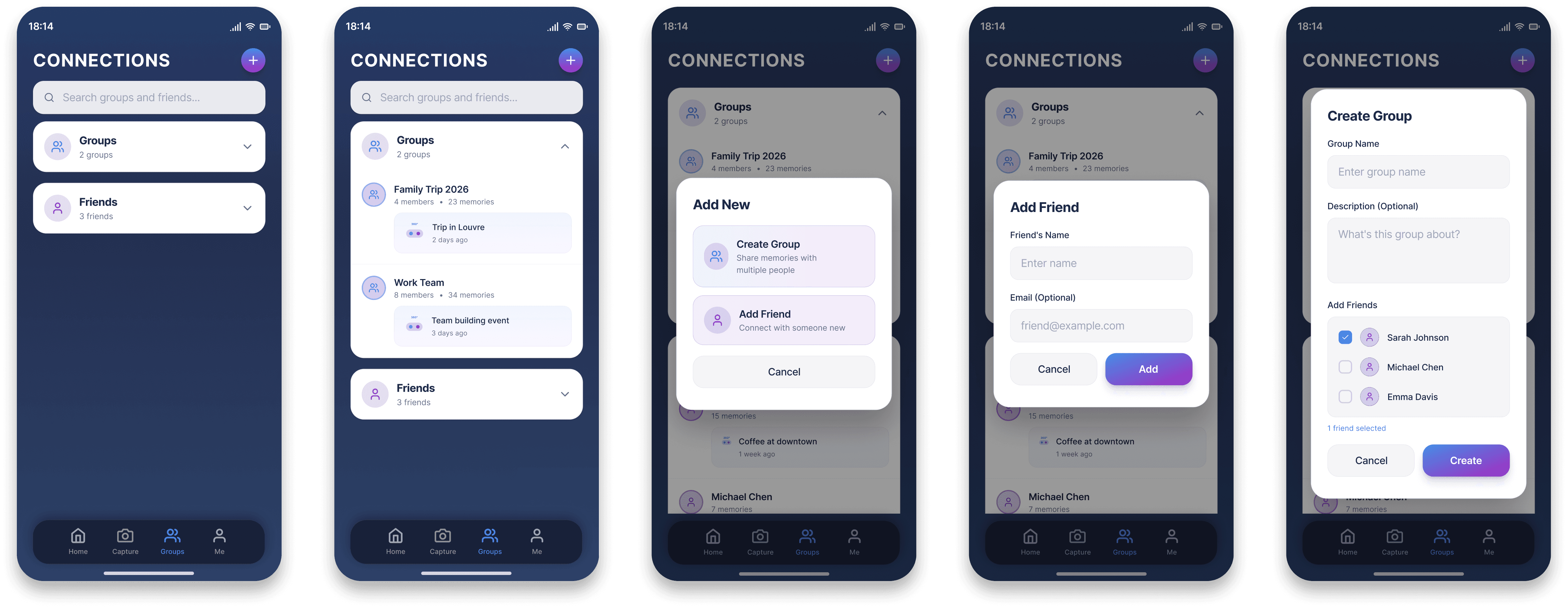
Groups — Friends and group management, shared memories and social connections
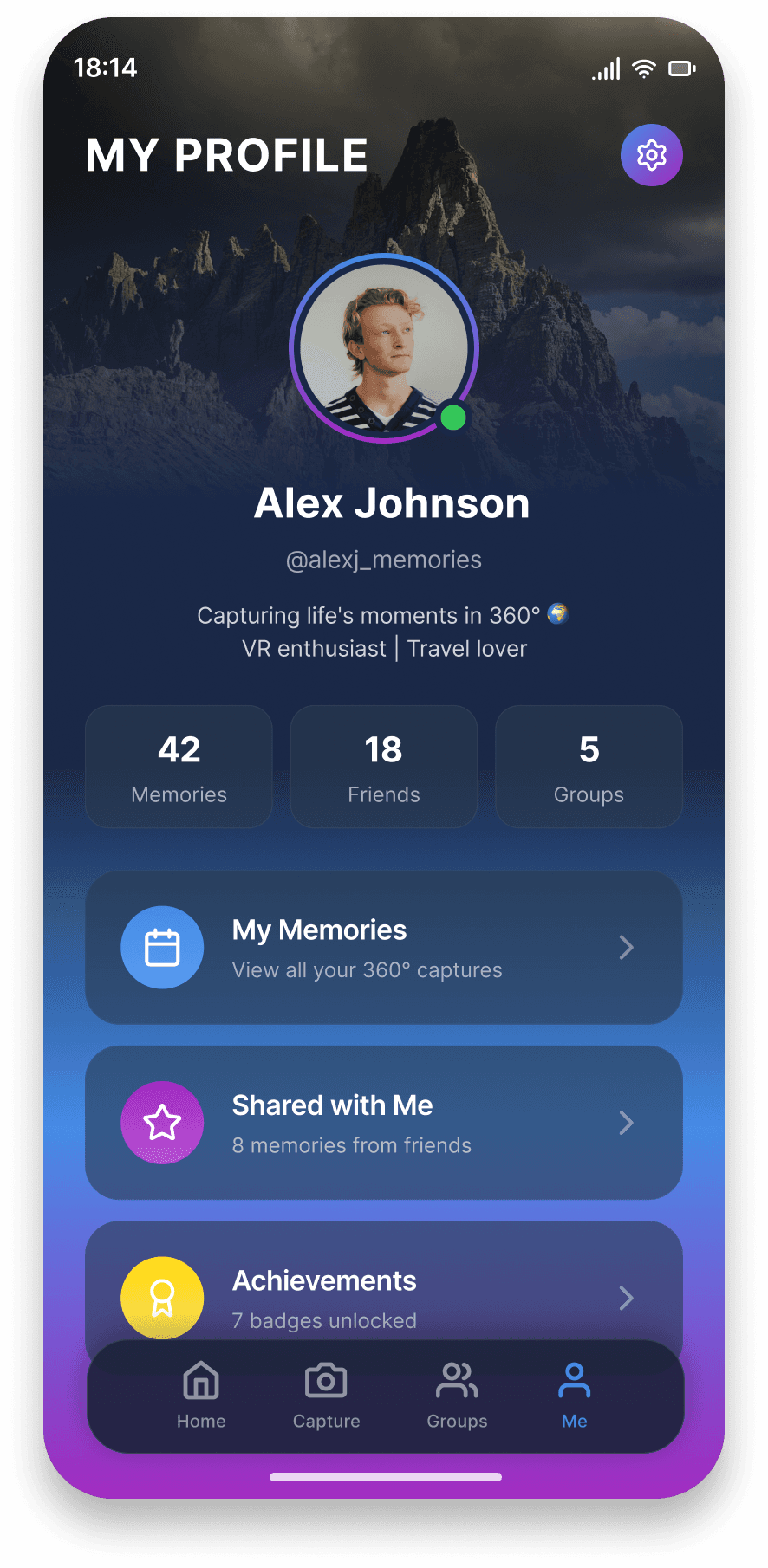
Me — Personal information, statistics, and settings management
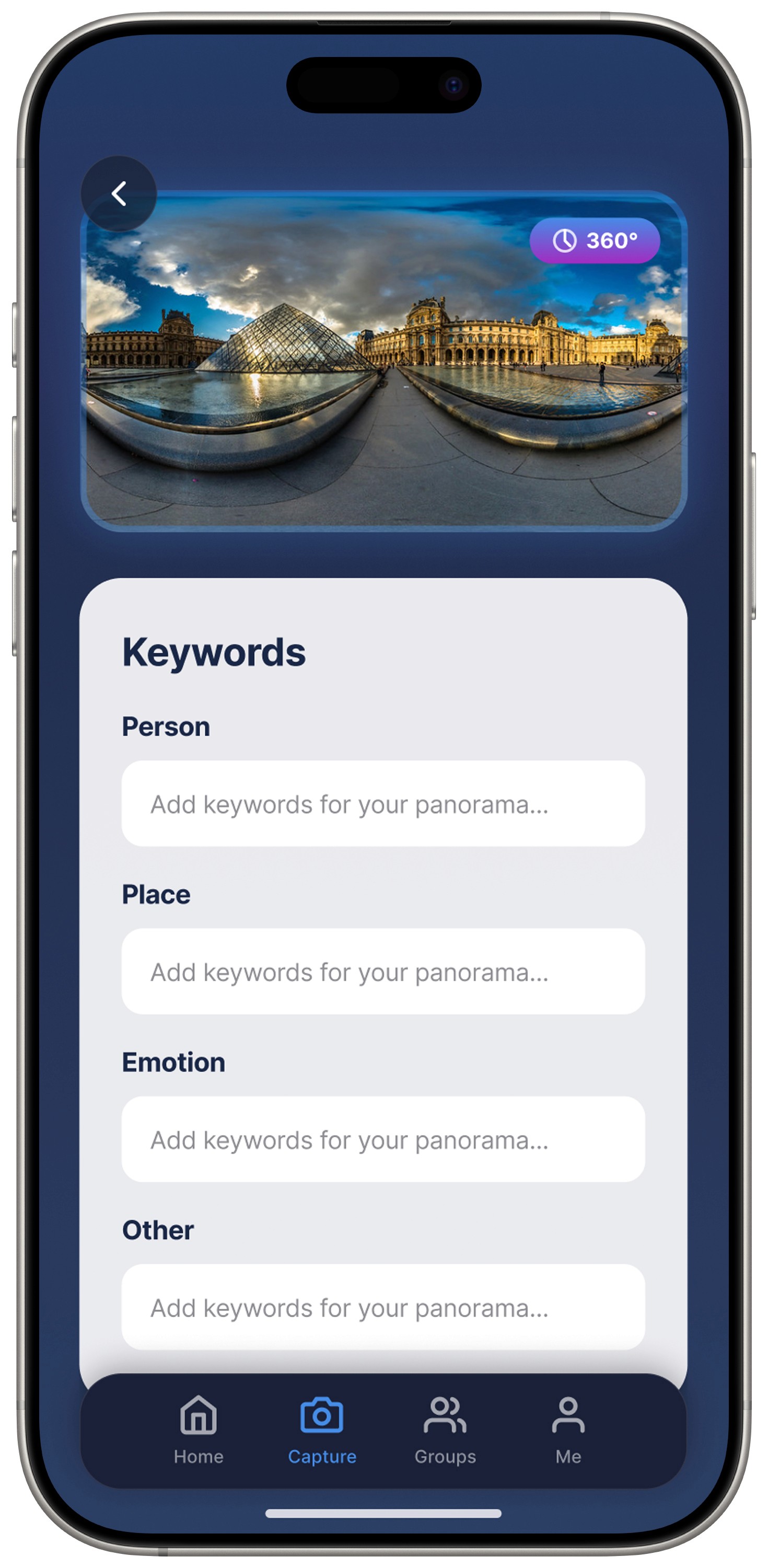
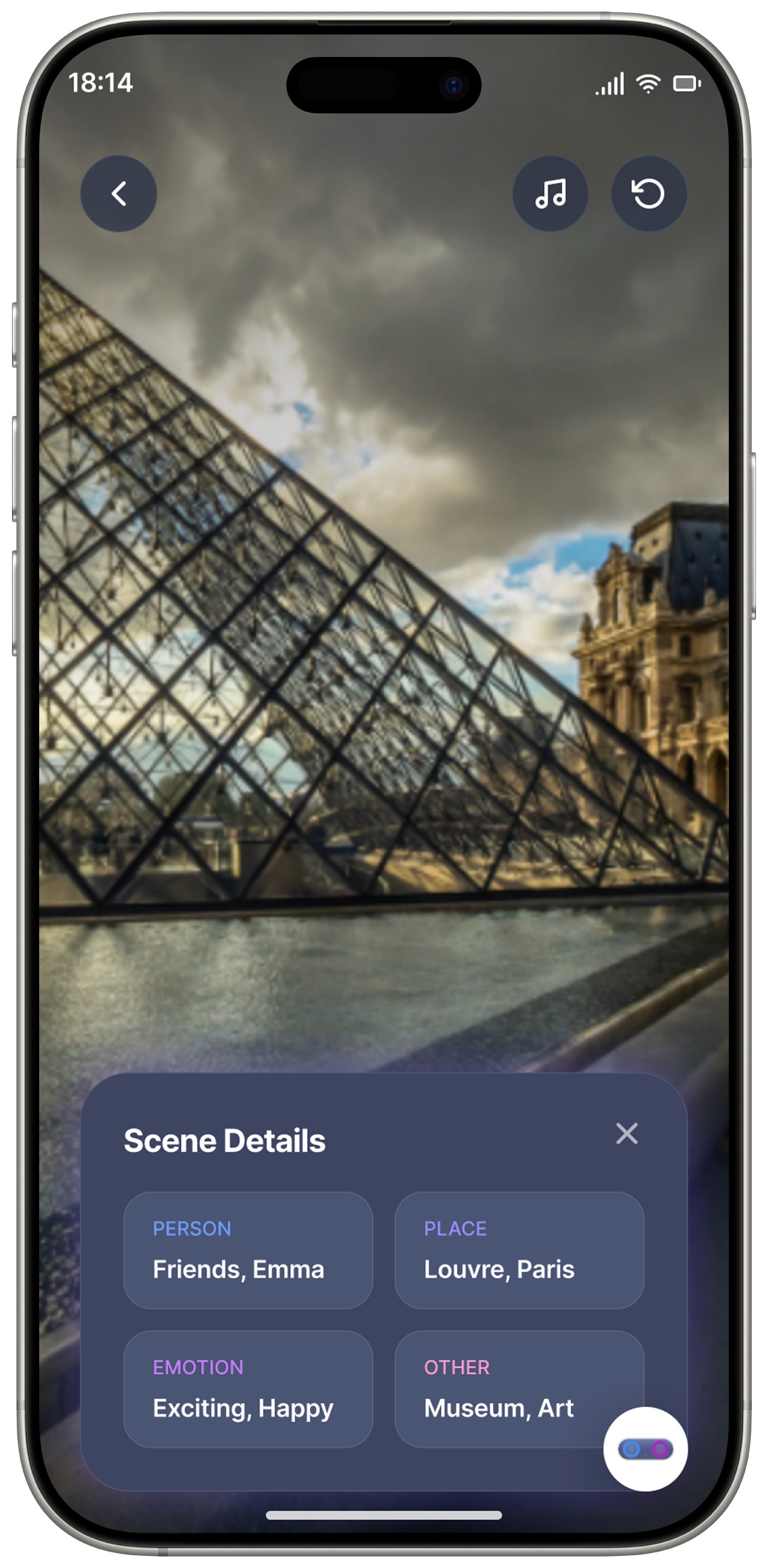
Browse & View — Panoramic memory browsing, keyword cards, and VR immersive viewing
Home
Capture
Groups
Me
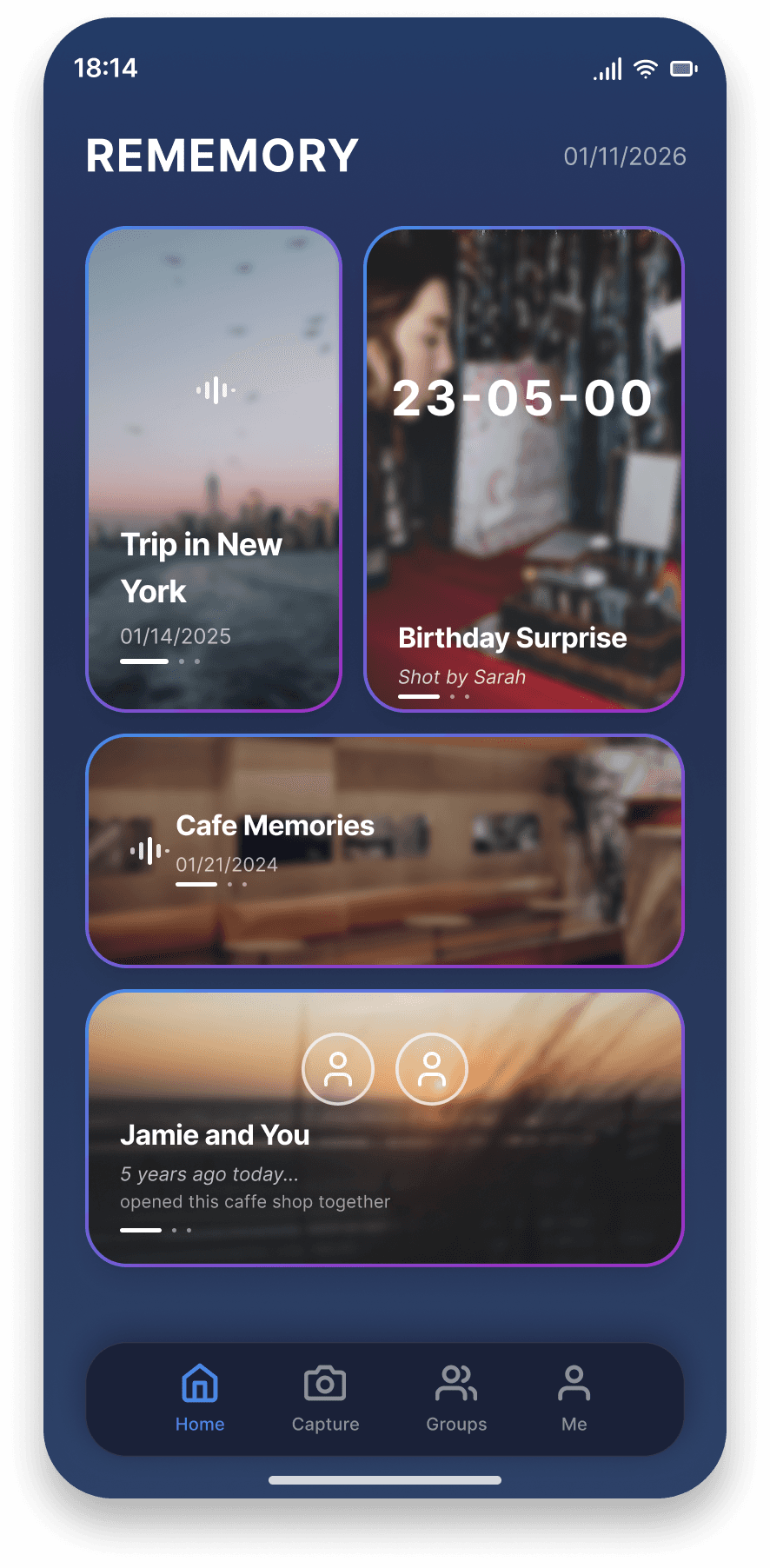
Key Screens
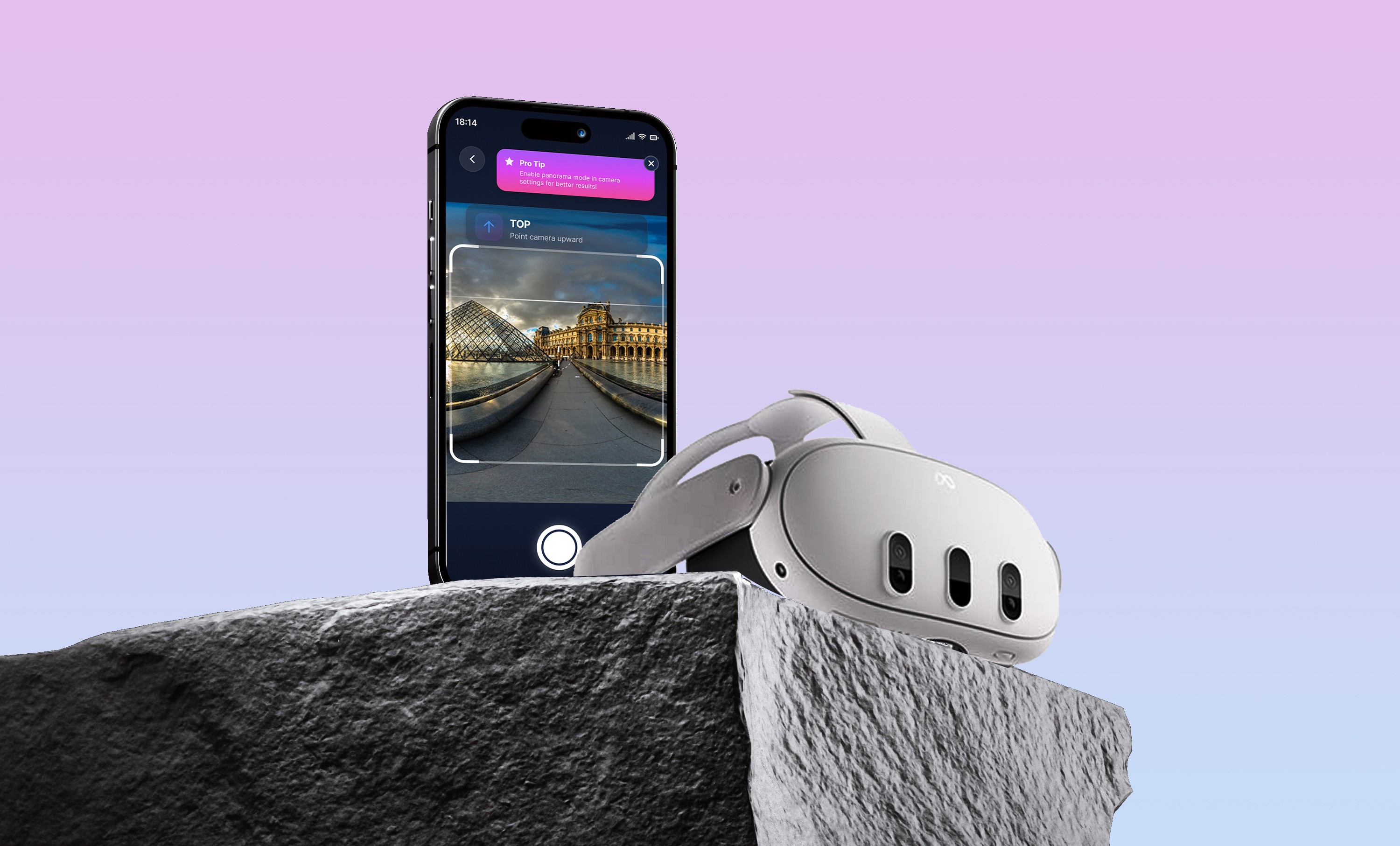
Six-Angle Capture Guidance — Visual progress indicator for multi-directional shooting
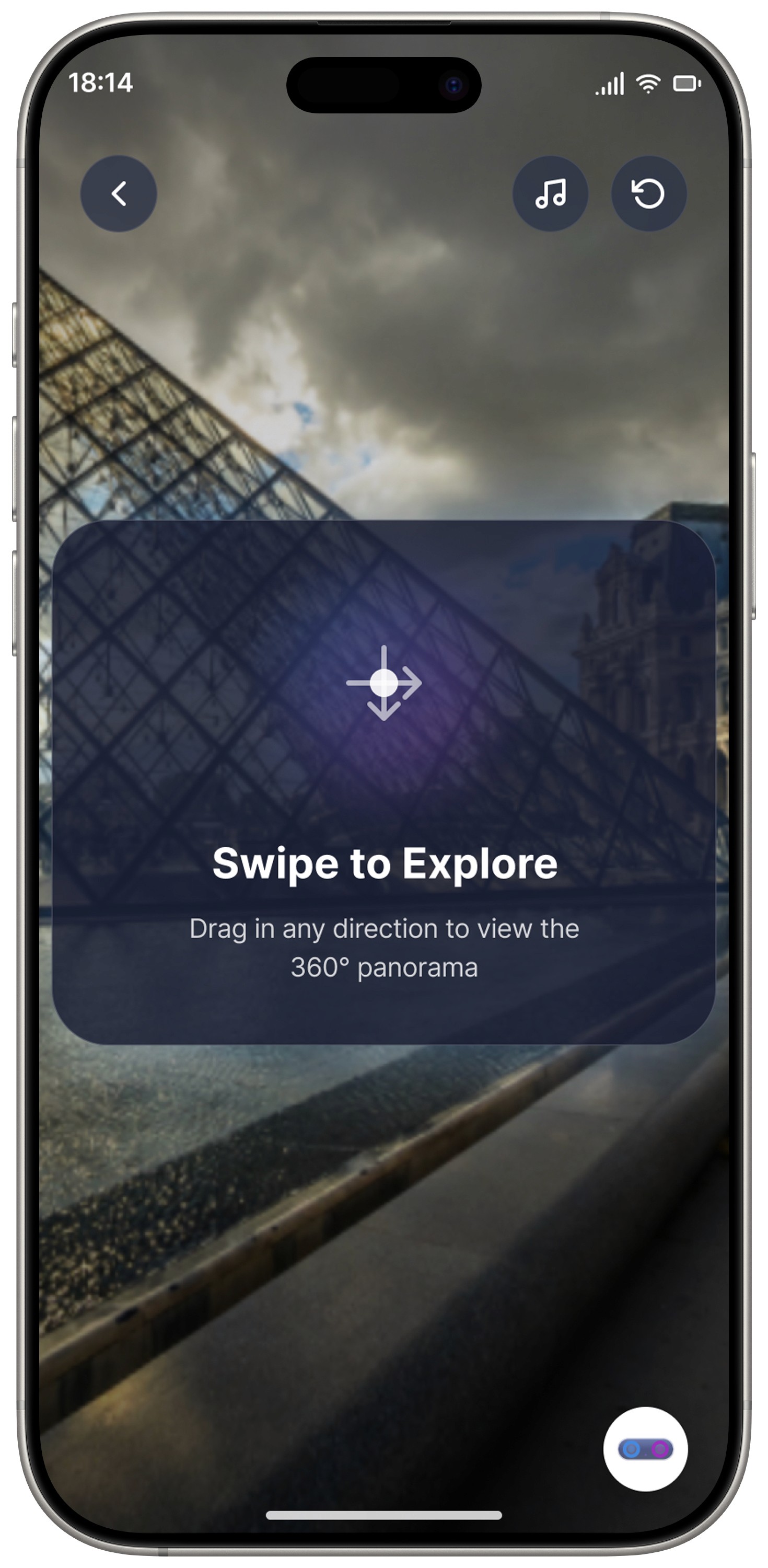
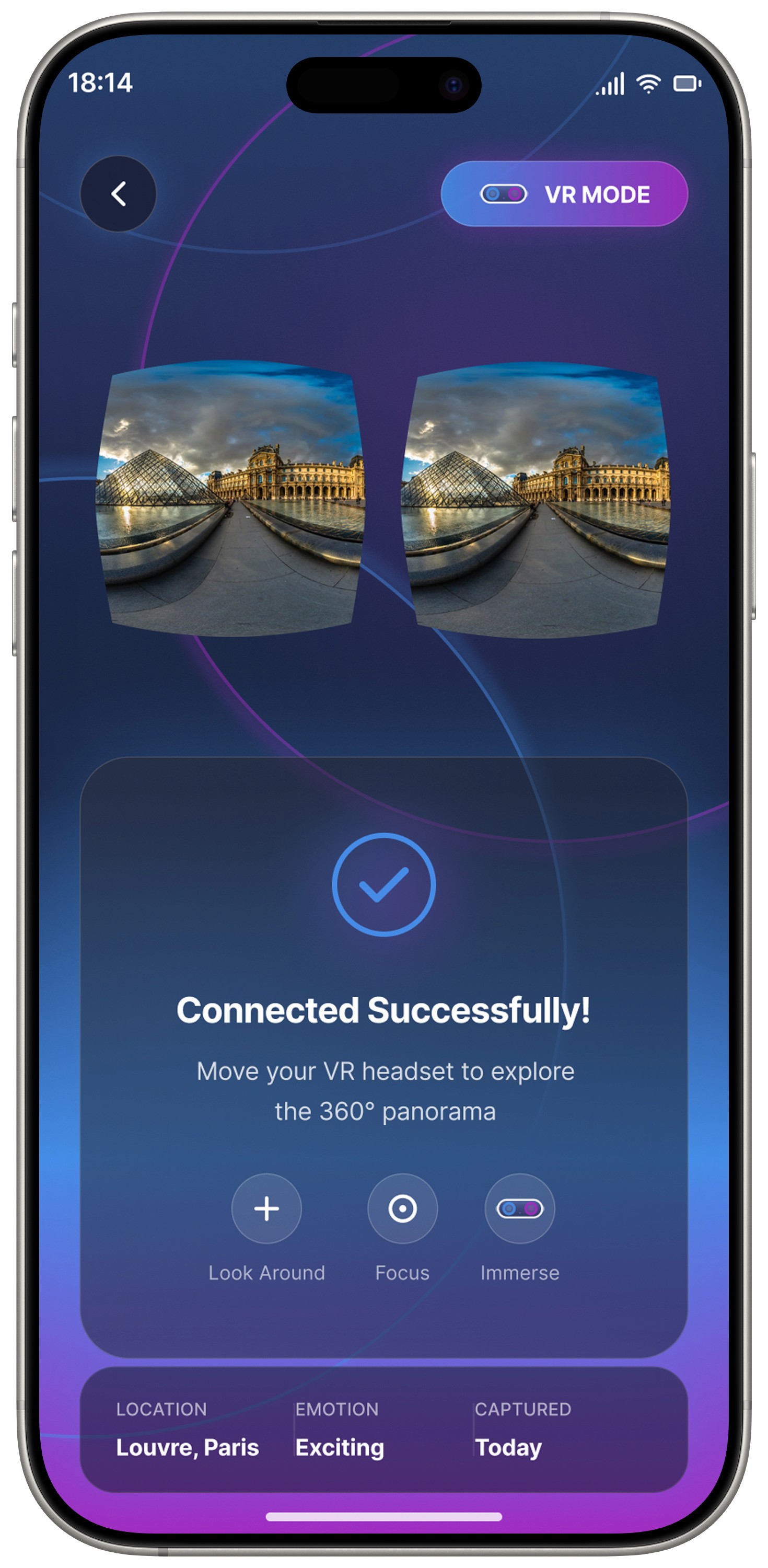
Immersive Panorama Viewer — Gesture interactions + Keywords card overlay
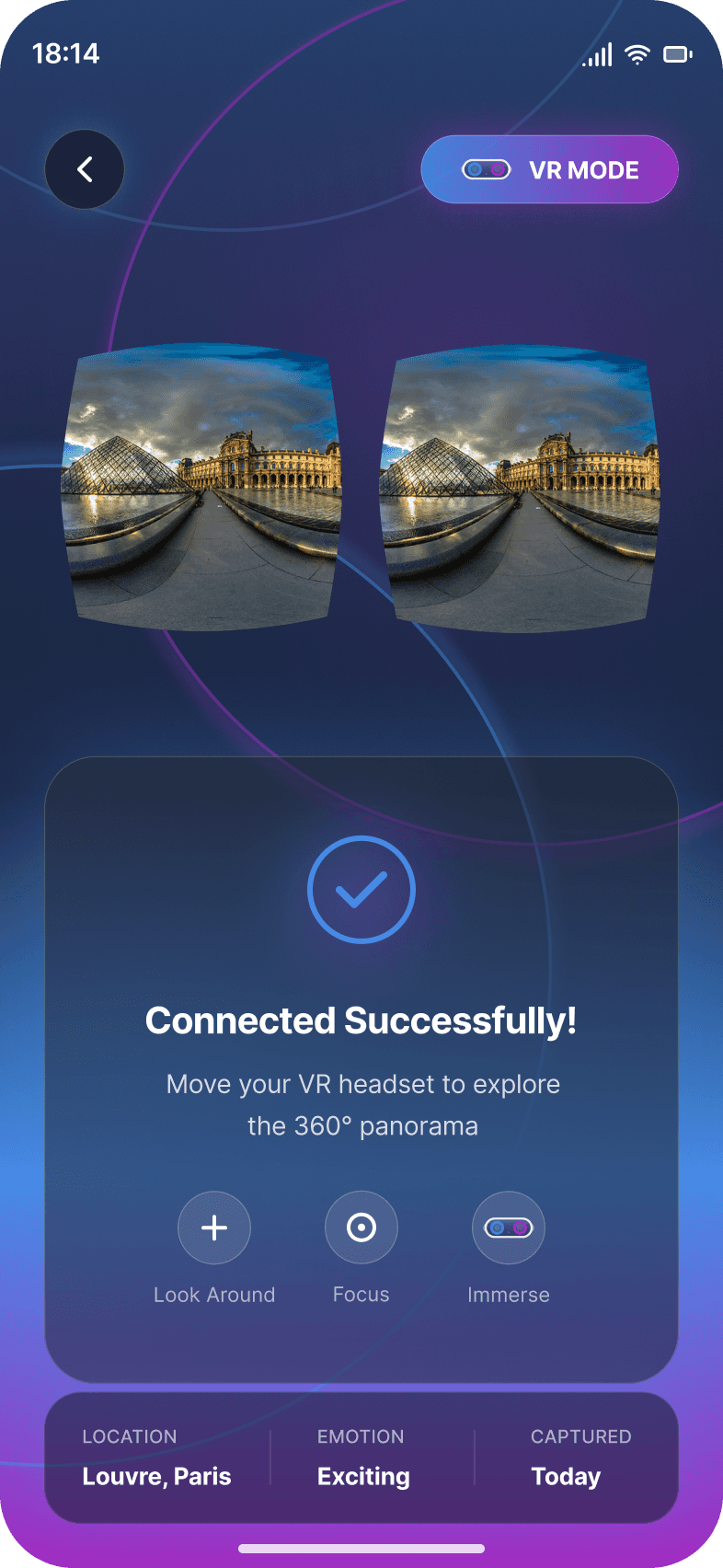
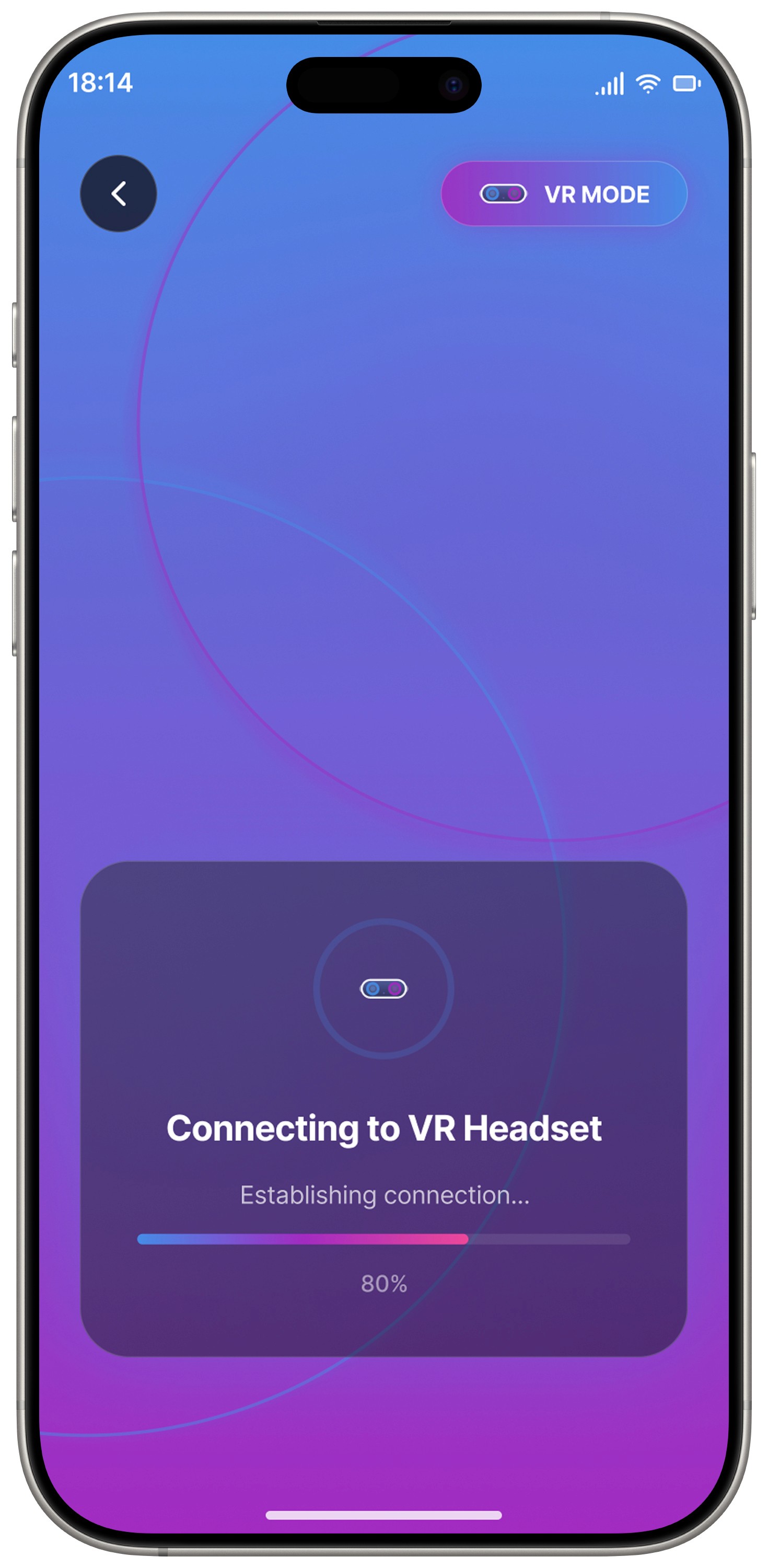
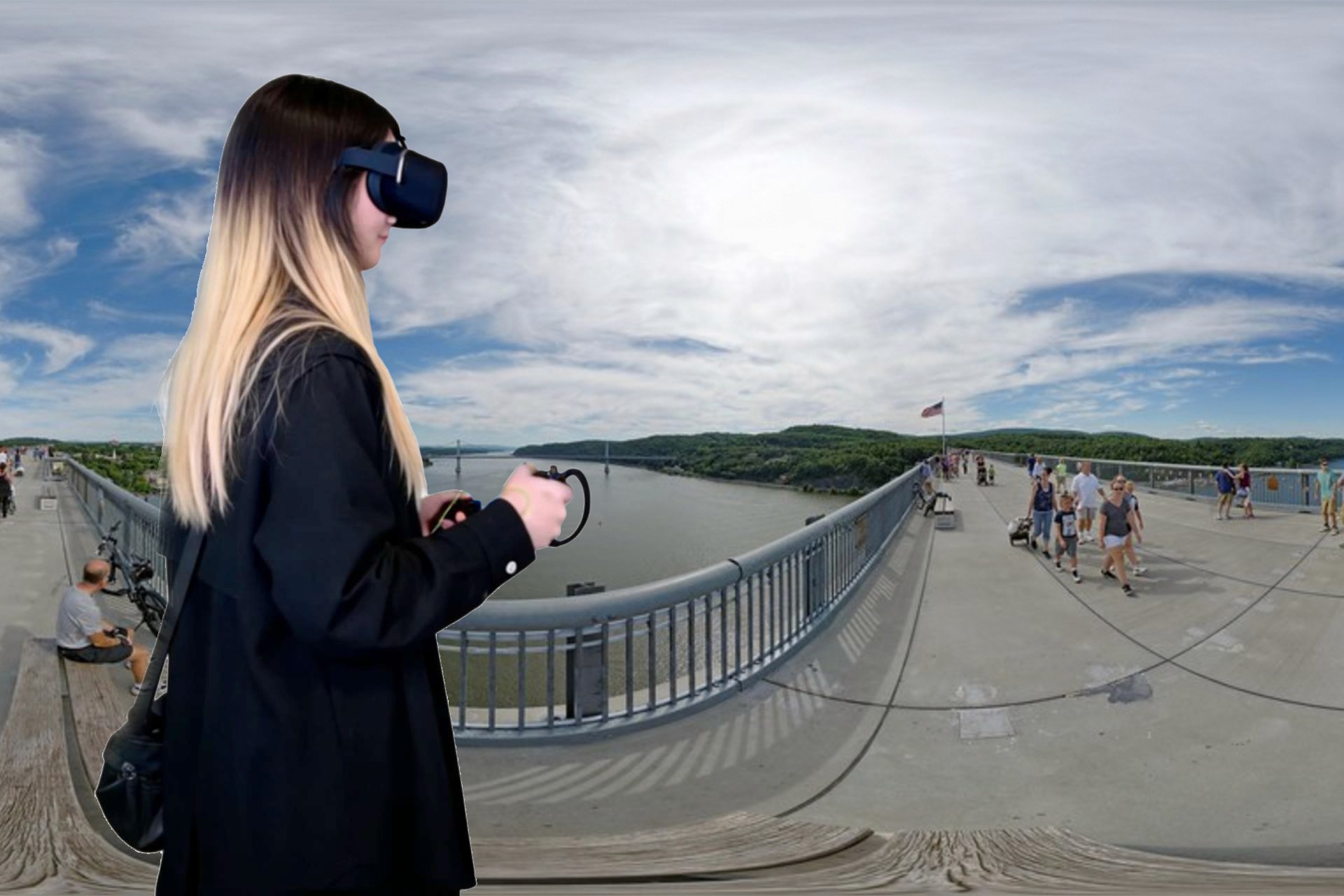
VR Glasses Mode — Dual-view split screen with device connection animation
Friends & Groups Management — Memory sharing and relationship network visualization
VR Mode
Connect your VR device and experience memories in an immersive way.
Usability Testing & Iteration
Testing Setup
6 participants from target group.
Scenario-based tasks (create, revisit, and reflect on a memory).
Think-aloud protocol + post-test interviews.
Metrics
Task Completion: 90% for core flows.
Perceived Emotional Connection: Rated 4.2 / 5 on average.
Usability (SUS):Average score 82.
Outcomes & Learnings
Metrics
Engagement: Prototype tests showed 24.86% longer session time vs. baseline gallery pattern.
Emotional Recall: Users reported a stronger sense of connection in 29% more sessions.
Retention Intention: 5/6 participants said they would use this weekly.
Key Learnings
Emotional design requires careful balance between interaction richness and cognitive load.
Mixed-method research is crucial to capture both measurable behavior and nuanced feelings.
Translating an artistic concept into a product requires reframing around user and business value.
Next Steps
Explore AI-assisted reflection: sentiment analysis across memories.
Build social layer for shared memory spaces among close relationships.
Test potential partnerships in digital wellness and mental health.